A spray tan is meant to give you that even, just-back-from-holiday glow - until your hands go patchy and your ankles go strange. The culprit is usually absorption zones: areas where skin drinks in more (or less) colour because it’s thicker, drier, more mobile, or more exposed to daily wear. If you know why those spots misbehave, you can prep and maintain them without turning your bathroom into a chemistry lab.
You’re not “bad at tanning”. You’re just dealing with two body parts that work harder than the rest of you.
The quick truth: hands and ankles live a tougher life
Your torso mostly sits under clothes, moves in predictable ways, and isn’t constantly washed, sanitised, and rubbed against things. Hands and ankles do the opposite.
Hands are the business end of your day: soap, hot water, hand gel, steering wheels, gym grips, handbag straps, constant rinsing. Ankles are the friction zone: socks, boots, trainers, tight jeans hems, and that dry ring where your skin thickens from footwear and weather.
When a spray tan develops on top of that, it’s trying to be uniform on a surface that absolutely isn’t.
Absorption zones: where colour grabs, then lets go
A spray tan works by reacting with the dead layer of your skin. That layer isn’t identical everywhere, and that’s why absorption zones matter more than the brand you used or whether you “left it on long enough”.
On hands and ankles, you tend to get two extremes at once:
- Over-absorption on dry, thick patches (knuckles, around the nails, the sides of feet, back of ankles).
- Fast fade on high-wash, high-friction patches (palms, fingertips, the front of ankles where socks rub, any bit you scrub without thinking).
So you can end up with darker edges and lighter centres, or a “ring” effect where the colour clings to dryness but disappears where you move most.
Hands: the perfect storm of water, soap, and creases
Hands fade unevenly for boring, practical reasons - and that’s actually good news, because boring reasons are fixable.
1) You wash them constantly (and not gently)
Every wash is mild exfoliation. Add hot water, foaming soaps, and hand sanitiser and you’ve got a daily peel. The tan doesn’t just fade; it breaks up, because some parts of the hand take more punishment than others.
The back of the hand might hold colour while fingertips go pale. The webbing between fingers might stay darker because product pooled there and you didn’t wash that spot with the same force.
2) Tan collects in the places you don’t notice
Knuckles, cuticles, and the sides of fingers have more texture. If you apply as if your hand is a flat sheet, the solution settles into lines and edges and develops darker there.
Then, because those areas are also drier, they hold on longer - which makes the contrast look worse as the rest fades.
3) Palms don’t behave like the back of the hand
Palms are thicker, sweatier, and more likely to be washed and rubbed. Many people instinctively avoid the palm (good), but then they accidentally transfer product with a half-wet hand or by touching their face/clothes mid-application (not so good).
The result is that tell-tale mismatch: backs look bronzed, palms look stark, and the line at the side of the hand gives you away.
Ankles: friction, dryness, and the “sock line” problem
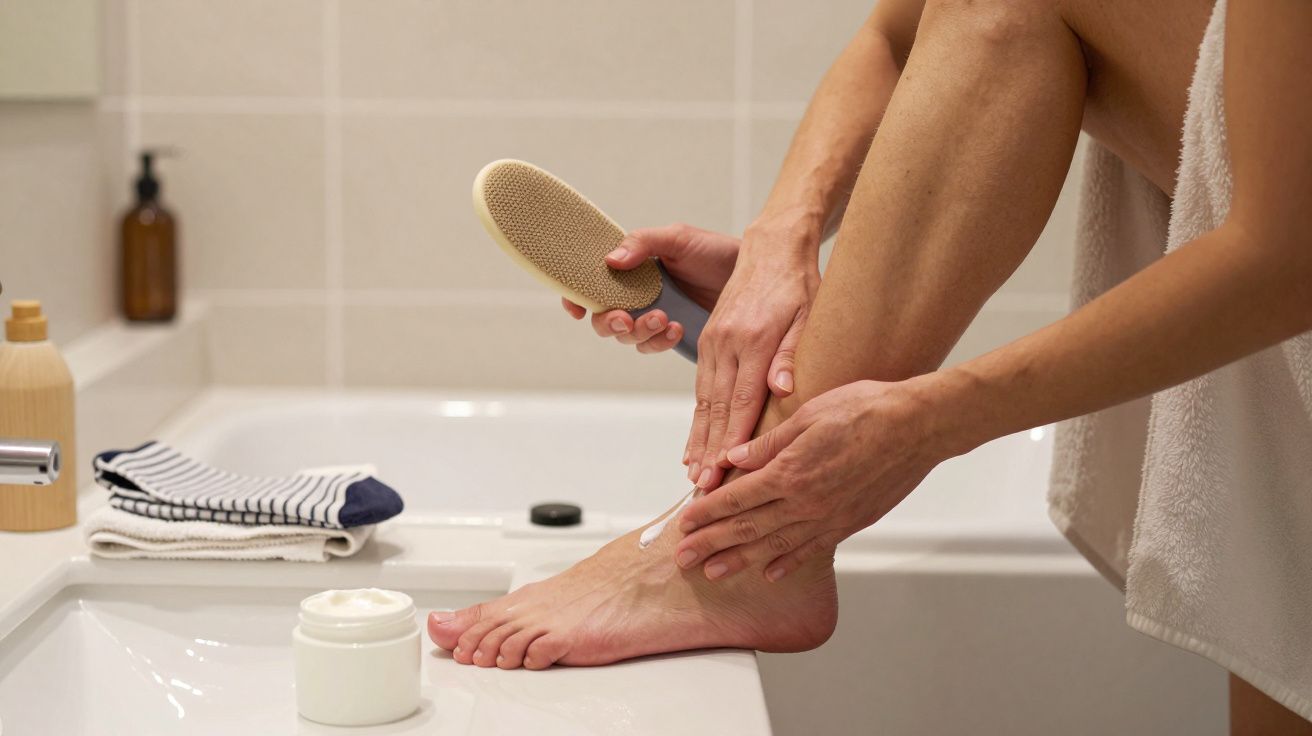
Ankles are less about washing and more about contact. If hands are soap, ankles are sandpaper.
1) Socks and shoes create a daily fade map
Even soft socks create repetitive rubbing in the same band. Trainers add pressure points. Boots add heat and sweat. The tan doesn’t fade evenly because the friction isn’t evenly distributed - it’s a ring, a seam, a hot spot.
If you’ve ever noticed colour disappearing faster on the front of the ankle or right above the heel, that’s your footwear writing its signature.
2) Ankles are naturally drier (and often missed in moisturising)
Many people moisturise calves, then stop at the ankle like it’s a border. Ankles also have bony contours and tendons, which means product can cling to edges and develop darker there.
Dryness makes the tan grab, but it also makes it shed in flakes. That’s how you get both too dark and too patchy, sometimes in the same day.
3) Movement breaks up the tan’s “film”
Every step folds the ankle skin. If the tan developed more heavily in the creases or along the tendon lines, those areas can look striped as the rest fades. It isn’t that the tan is “cracking” like paint - it’s that the surface layer is being worn away unevenly.
Where application goes wrong (even when you’re careful)
Most uneven fade starts on day one. Not because you did something terrible, but because hands and ankles punish small mistakes.
Common slip-ups:
- Applying the same amount of product everywhere, instead of treating hands/ankles as lighter-touch zones.
- Forgetting to remove jewellery, then scrubbing around it later (instant patch).
- Letting solution pool between fingers or around the ankle bone.
- Getting dressed too soon and creating a rub point before the tan has fully settled.
If you want one guiding principle, it’s this: hands and ankles should look slightly underdone on application day so they look normal on day three.
A practical routine that makes fading look intentional
You don’t need perfection. You need consistency in the places that usually get ignored.
Prep day (or at least a few hours before)
- Exfoliate, but don’t attack hands and ankles with a harsh scrub right before tanning.
- Moisturise dry edges lightly: knuckles, cuticles, sides of feet, back of ankles.
- If you shave, do it earlier rather than right before, especially around ankles where irritation can grab pigment.
Application day: treat them as “detail work”
- Use less product on hands and ankles than everywhere else.
- Blend what’s left on the mitt rather than doing a fresh pump.
- For ankles: bend the foot slightly and blend over the bone/tendons so it doesn’t settle in a sharp line.
- Wipe palms and nails promptly if there’s any transfer.
Maintenance (the bit most people skip)
- Moisturise daily, especially ankles and the backs of hands.
- After handwashing, apply a quick hand cream - boring, but it works.
- Avoid aggressive exfoliating “just on the patch” unless you’re committed to evening out the whole area.
Fast-look cheat sheet
| Area | Why it fades unevenly | What helps most |
|---|---|---|
| Hands | Washing, sanitiser, pooling in creases | Less product + frequent moisturiser after washing |
| Ankles | Socks/shoes friction, dryness around bone | Light barrier moisturiser + careful blending over contours |
| Both | Absorption zones grab colour, then shed at different speeds | Under-apply slightly; hydrate daily |
FAQ:
- Why do my hands go orange but the rest looks fine? Hands often have drier knuckles and more creases, so colour develops stronger in those absorption zones. Using less product on hands and moisturising knuckles/cuticles before application usually prevents that “grab”.
- Should I put fake tan on my palms and soles? Generally no, or only the faintest blended residue. Palms and soles are thicker and wash/rub constantly, so they tend to look unnatural and fade in a messy way.
- How do I fix patchy ankles without stripping my whole tan? Gently exfoliate just enough to smooth flaking edges, moisturise, then lightly top up with the remaining product on your mitt (or a gradual tanner) blended over the ankle bone.
- Does barrier cream actually work? Yes, when used sparingly. A thin layer on knuckles, cuticles, and dry ankle areas reduces over-absorption so the fade looks more even later.




Comments (0)
No comments yet. Be the first to comment!
Leave a Comment