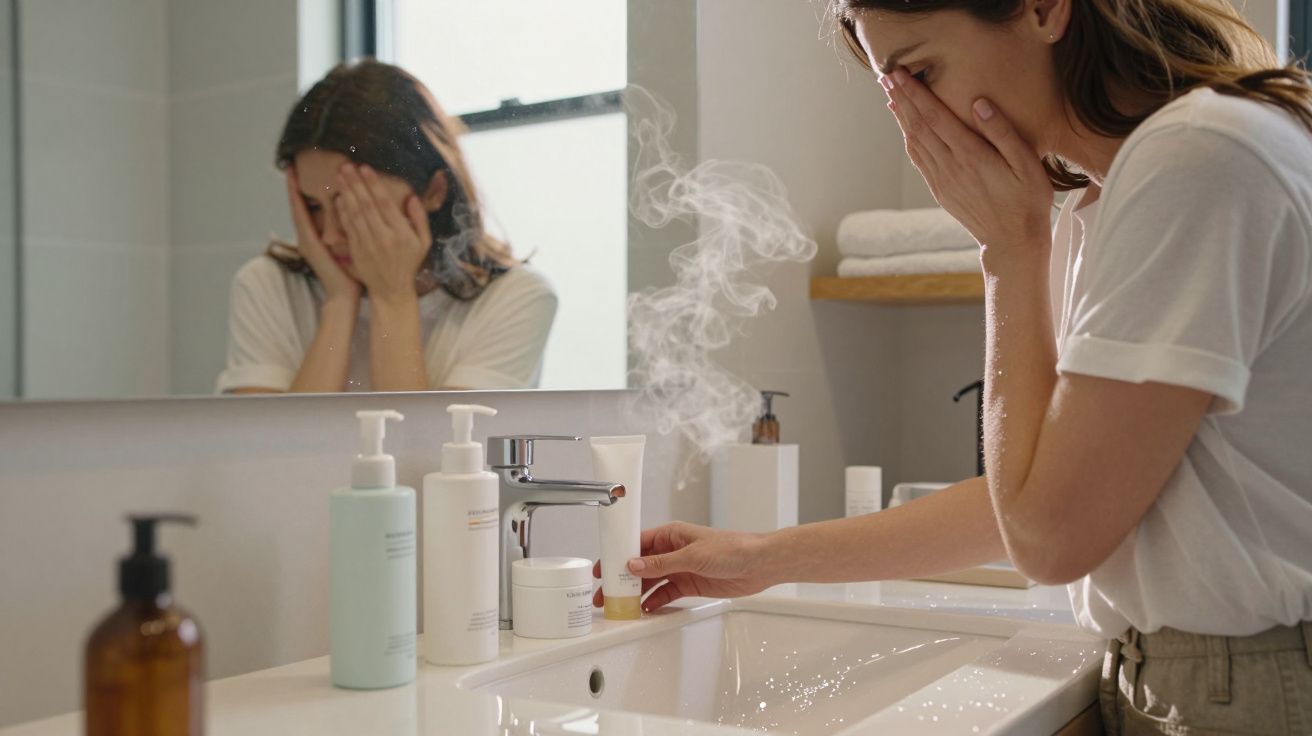
Skinimalism shows up in the most ordinary place: your bathroom shelf, where minimal skincare quietly replaces the old “more is more” logic with a tighter routine you’ll actually stick to. It matters because irritated, overworked skin is common, products are expensive, and most of us don’t have the time (or patience) for ten steps twice a day. The appeal isn’t austerity for its own sake; it’s getting better results by doing fewer things, more consistently.
You know the feeling: you buy the serum everyone swears by, then add an acid “for texture”, then a retinol “for lines”, then a new cleanser because the old one is “too stripping”. A month later your face is tight, shiny, and inexplicably sensitive, and you’re googling “damaged skin barrier” at midnight. The routine is technically advanced, emotionally exhausting.
Then someone says: stop. Strip it back. Let your skin breathe.
The small shift that changes the whole routine
Skinimalism isn’t “anti-skincare”. It’s a decision to treat skincare like a system, not a collection. You pick a few high-value steps and you stop stacking actives that compete, clash, or simply overwhelm your barrier.
In practice, it’s often three pillars: cleanse, moisturise, protect. Everything else becomes optional, and it earns its place rather than squatting on the shelf because the packaging was convincing.
The shift feels almost too simple, which is why it works. Like the “two drops” trick in a cleaning routine, the power is in restraint. Fewer steps means fewer variables, fewer reactions, and a clearer read on what’s helping.
Why “more products” stopped feeling like progress
There are a few forces pushing people towards minimal skincare, and none of them are particularly mysterious.
First, skin is tired. The last decade made strong actives mainstream: acids, retinoids, peels, “daily exfoliating” anything. Used well, they’re brilliant. Used together, casually, they can turn a normal face into a reactive one.
Second, the cost-of-living reality has made the maths obvious. If you’re buying five things to fix what the other five things broke, it’s not a routine - it’s a loop.
Third, there’s a new kind of literacy online. People have learned the words for what they’re experiencing: barrier function, transepidermal water loss, irritation vs purge, sensitisation. Once you can name the problem, you stop trying to solve it by adding another bottle.
A good skinimalist routine doesn’t shout. It calms things down so your skin can behave like skin again.
What a skinimalist routine actually looks like (day to day)
Most people don’t need a dramatic “skincare detox”. They need a reset that is gentle, boring, and repeatable. Here’s the simplest framework that suits most faces:
- AM: gentle cleanse (or rinse), moisturiser, SPF
- PM: cleanse, moisturiser
- Optional: one “treatment” step a few nights a week, chosen for a specific goal
The detail lives in the choices. “Gentle” means it doesn’t leave you squeaky or tight. “Moisturiser” means it leaves you comfortable for hours, not minutes. “SPF” means every day, even when it’s grey, because UV doesn’t wait for summer.
Treatments are where routines usually go off the rails. Skinimalism doesn’t ban them; it makes you use them like you mean it.
The unglamorous logic: fewer actives, clearer skin
If you’ve ever tried to troubleshoot a face that’s stinging, peeling, and breaking out at the same time, you know the problem with complicated routines: you can’t tell what’s doing what.
Skinimalism fixes that by reducing “noise”. When there are fewer steps, changes become easier to interpret. If redness drops after two weeks of a simpler routine, you have a useful clue. If a product causes irritation, you’ll spot it quickly instead of guessing between six new additions.
It also protects consistency, which is where skincare actually lives. A routine you can do when you’re tired, travelling, or stressed will beat a perfect routine you do twice and abandon.
How to go minimal without feeling like you’re doing nothing
This is the part people get wrong: they remove everything except an acid and wonder why their skin feels raw. Minimal skincare isn’t “no care”. It’s “enough care”.
A practical way to simplify without panic:
- Keep SPF and moisturiser. These are your baseline insurance policies.
- Choose one cleanser you tolerate. If makeup/SPF is heavy, use a proper cleanse at night.
- Pick one treatment max. Retinoid or exfoliant or pigment reducer. Not all at once.
- Run it for 3–4 weeks. Skin needs time to show you the result.
- Add only if there’s a clear purpose. “Because TikTok said so” isn’t a purpose.
If your goal is acne, your “one treatment” might be a retinoid or benzoyl peroxide (used carefully). If your goal is dullness, it might be a mild chemical exfoliant once or twice a week. If your goal is calm, it might be no treatment at all - just barrier support for a month.
The cultural pull: skin that looks like skin
There’s also a quieter reason skinimalism is reshaping facial routines: it suits the way people want to look right now.
Heavy base makeup has fallen out of favour for many, and when the goal is “fresh”, the fastest route isn’t another brightening serum. It’s reducing inflammation, restoring comfort, and letting texture exist without treating it like a flaw to erase.
Skinimalism aligns with that. It’s not perfection. It’s stability. And stability photographs well, feels better, and costs less in both money and mental load.
| Principle | What it means | Why it helps |
|---|---|---|
| Fewer steps | Cleanse, moisturise, SPF as the core | Less irritation, more consistency |
| One treatment at a time | A single active used with intent | Easier troubleshooting, better tolerance |
| Barrier-first thinking | Comfort and hydration before “results” | Calmer skin that responds more predictably |
FAQ:
- Is skinimalism only for people with sensitive skin? No. It suits anyone who wants fewer steps, but it’s especially helpful if you’re dealing with irritation, dryness, or unpredictable breakouts from product overload.
- Do I have to stop using actives to do minimal skincare? Not necessarily. Skinimalism usually means using fewer actives and using them less often, not banning them entirely.
- How do I know what to cut first? Start by pausing anything that stings, peels you, or overlaps with another active (for example, multiple exfoliants). Keep a gentle cleanser, moisturiser, and SPF.
- How long should I try a simplified routine before changing it? Aim for 3–4 weeks unless you have an obvious reaction. Consistency is the point; constant switching keeps you stuck.
- Will my skin look worse before it looks better? If you’re stopping harsh products, you may notice a short adjustment period, but many people see less redness and tightness within days. Persistent worsening is a sign to reassess and, if needed, speak to a pharmacist or dermatologist.


Comments (0)
No comments yet. Be the first to comment!
Leave a Comment