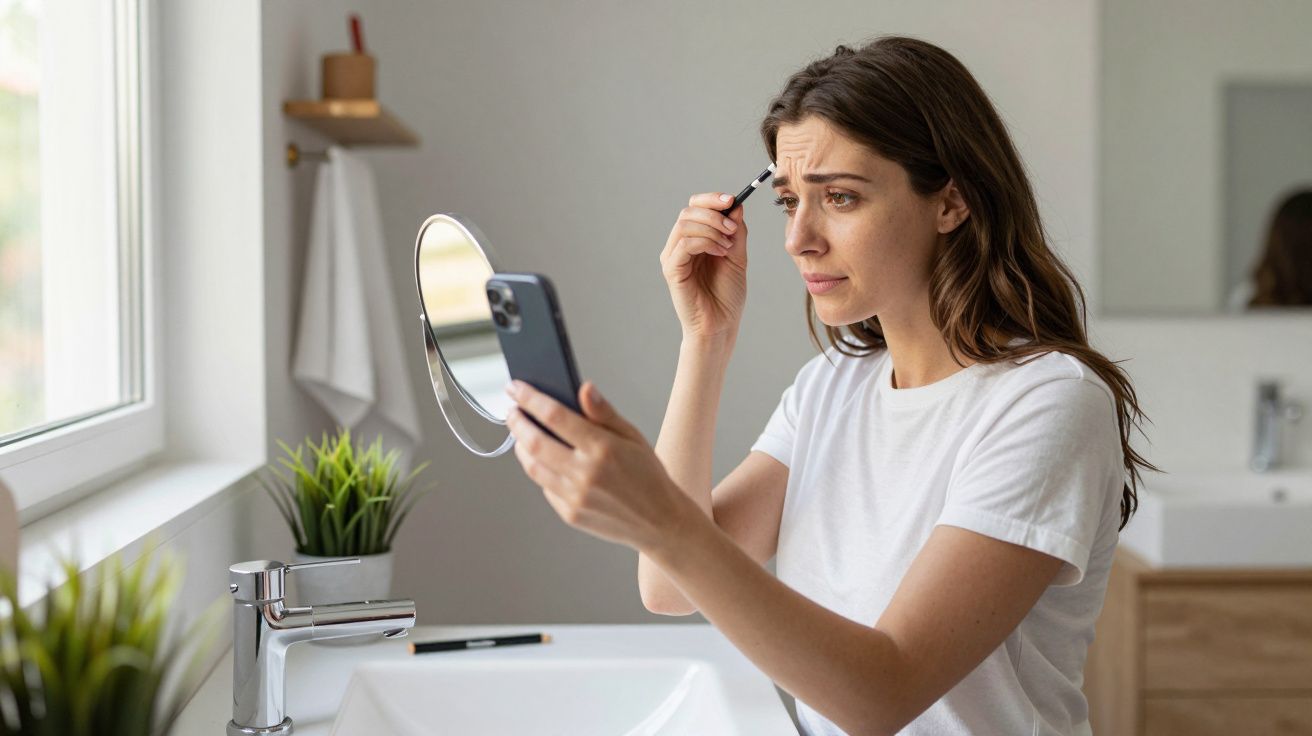
You can walk out of a salon with immaculate eyebrow shaping and still feel like something is “off” when you catch your reflection in daylight. That disconnect often has less to do with the brows themselves and more to do with facial proportions-how your features share space, direction, and visual weight across the whole face. It matters because brows don’t sit in isolation; they act like a frame, and a perfect frame can still tilt the picture.
The frustrating part is that the mirror doesn’t always explain what the camera shows. In one light your arches look crisp and even, and in another the face suddenly seems lopsided, heavier on one side, or oddly stern. It’s not that the shaping failed. It’s that “balanced brows” and “balanced face” are two different jobs.
The myth of “matching brows” as the same thing as harmony
Brows can be symmetrical on paper and still read as unbalanced in real life. That’s because the eye doesn’t judge them as two separate shapes; it judges the relationship between brows, eyes, nose, lips, hairline, and even the tilt of your head.
A small change in any one of those can throw the whole thing. A slightly higher eyelid crease on one side, a stronger cheekbone, a nostril that flares more when you smile-these aren’t flaws. They’re normal human asymmetry. But they change the context your brows are being read in.
If you’ve ever thought, “They’re identical, so why do they look different?” you’ve already bumped into the truth: the brow isn’t the only variable.
Where imbalance really comes from (and why it’s not your fault)
Most “unbalanced” brows are reacting to the face, not failing it. Here are the usual culprits that make perfectly tidy shaping look oddly placed:
- Natural asymmetry in eye height or lid space. One eye often sits a touch higher or opens a bit more, which makes the brow above it look higher even when it isn’t.
- Different brow bone projection. If one side of the forehead is slightly more prominent, the same arch can look sharper-or closer to the eye-on that side.
- Muscle habits. Many people lift one brow when they talk, concentrate, or smile. Over time, one side can look “more arched” simply because it’s more animated.
- Hairline and temple density. A fuller temple can make a tail look shorter; a sparse one can make it look like it’s drifting into the side of the face.
- Feature spacing. Wide-set eyes, a long midface, or a short forehead can change how much “room” the brow has to breathe.
None of this requires a dramatic difference to be noticeable. Faces are read in patterns, and tiny shifts in pattern feel loud.
The three “brow measurements” people forget to check
Most people judge brows by shape: start, arch, tail. Professionals also look at placement-where that shape sits in relation to facial proportions.
A quick way to think about it is to check three relationships, not three lines:
- Brow-to-eye distance (vertical space). If you have one eyelid with more visible lid space, identical brows can look mismatched because the “gap” beneath them is different.
- Tail direction (horizontal pull). A tail that dips slightly can drag the whole face down on that side, especially on faces with softer jawlines.
- Front thickness and weight (visual mass). If the inner brow is too bold, it can make the nose bridge appear narrower or heavier, depending on your features.
You can have a beautiful arch and still have the brows argue with the rest of the face. Balance is less about perfection and more about agreement.
Why “perfect” often means “too perfect” for real faces
There’s a reason brows can look uncanny when they’re overly matched. A face with natural asymmetry reads as alive; brows that are cloned read as stamped-on.
This shows up a lot with strong mapping and sharp carving. When both arches peak at exactly the same distance and the fronts are equally squared, the brows can start to look like they’re sitting on top of the face instead of belonging to it.
A brow artist once put it to me like this:
“Your brows don’t need to be twins. They need to look like they grew up in the same family.”
That line sticks because it’s practical. The goal is not identical geometry; it’s a believable pair that supports the face you actually have.
What to do instead: shape for proportion, not symmetry
If your brows are “perfect” but feel unbalanced, the fix is often subtle-more adjustment than overhaul. The most useful approach is to correct the impression rather than chase absolute equality.
Try this mental checklist (or bring it to your appointment):
- Soften the higher side rather than raising the lower. Lifting one brow to match the other can quickly steal lid space and make the eye look smaller.
- Adjust the tail before touching the arch. Tiny changes in tail length or angle can level the face without changing your whole expression.
- Let the fronts differ slightly in density. One side often needs a lighter start to avoid looking harsher, especially if one eye is more open.
- Choose the right finish for your face. Crisp, outlined brows can overpower delicate features; diffused edges often sit better on softer facial proportions.
At home, photograph your face straight-on with a neutral expression, then with a small smile. If the “imbalance” only appears when you smile or speak, you’re looking at muscle movement, not a shaping mistake-and the solution is usually softer styling, not more removal.
A practical way to talk about it in the chair
If you don’t know how to explain what’s wrong, describe the effect you see rather than the technical flaw. Say things like:
- “This side looks heavier in photos.”
- “My face looks like it’s tilting.”
- “One brow makes me look more surprised/tired.”
- “The tails feel like they pull my eyes down.”
That language directs the work back to facial proportions, where it belongs. It also gives your brow artist permission to keep the shapes slightly different so the face looks even.
| What you’re noticing | Likely cause | What usually helps |
|---|---|---|
| One brow looks higher | Eye/lid asymmetry or forehead movement | Soften arch, reduce lift on “high” side |
| Face looks pulled down | Tail angle too low on one side | Slightly shorten/raise tail direction |
| Brows look harsh | Front too squared or too dark | Diffuse the start, lighten density/colour |
FAQ:
- If my brows are symmetrical, shouldn’t my face look balanced? Not necessarily. Brows sit on top of naturally uneven anatomy, so identical shaping can highlight differences in eye height, lid space, and bone structure.
- Should I pluck the “lower” brow higher to match the other? Usually no. Raising can reduce eyelid space and change your expression; balancing the higher side (softening, adjusting tail, reducing weight) often looks more natural.
- Why do my brows look fine in the mirror but odd in photos? Cameras flatten depth and exaggerate small differences in height and angle. Tail direction and brow “weight” often read stronger on camera than in person.
- Is this something lamination or tinting can fix? Sometimes. Styling can rebalance direction and density, but if the issue is placement relative to facial proportions, a softer tint or a less rigid lamination pattern is often the better move.



Comments (0)
No comments yet. Be the first to comment!
Leave a Comment