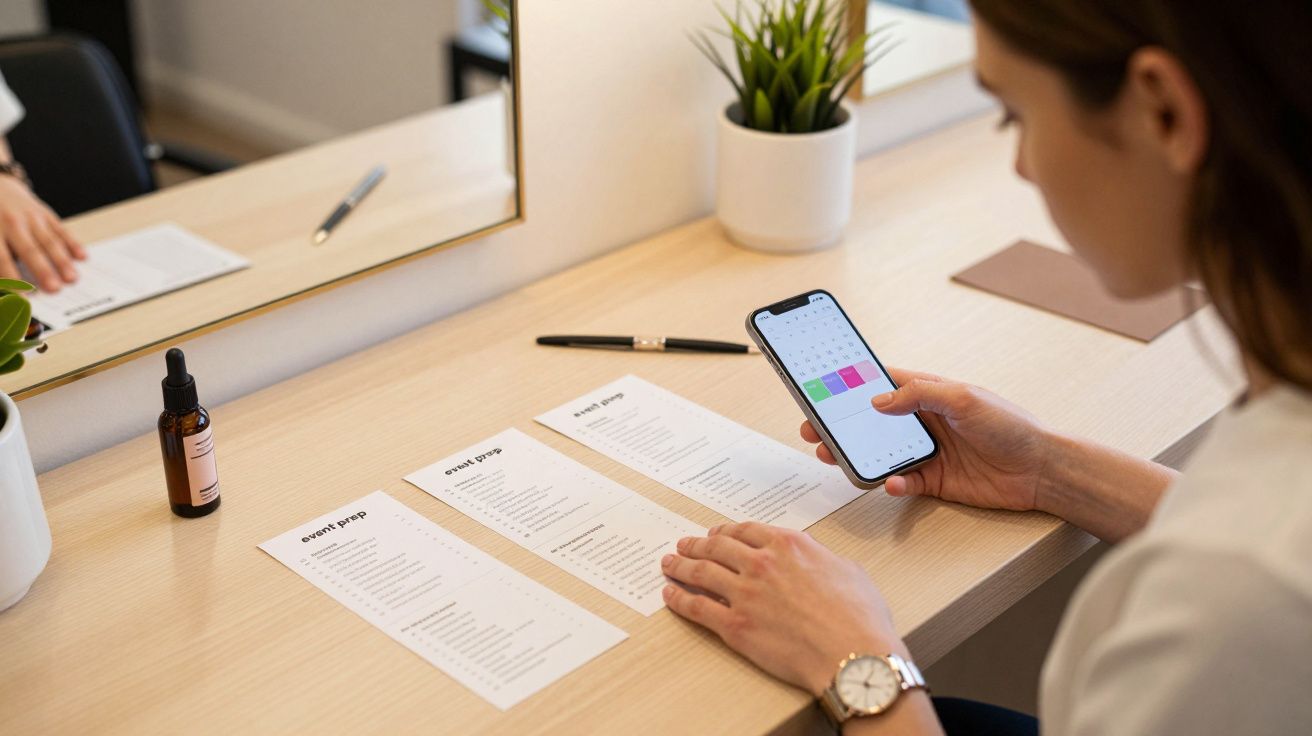
I used to think last-minute beauty bookings were a bad habit: a panic-wax here, a rushed facial there, hoping the mirror would forgive me by Saturday. Then I started watching what actually works under time pressure, especially before weddings, Christmas parties, work galas and holidays. The surprise is how often event packages beat single treatments-not because they’re fancy, but because they’re designed for real life.
When the clock is ticking, you don’t just need “a treatment”. You need a sequence that lands, on time, with fewer decisions and fewer ways to go wrong.
The uncomfortable truth about single treatments
A single treatment looks clean on a price list. One slot, one therapist, one outcome. In practice, it rarely lives alone.
You book a facial, then realise your brows need doing. You do your nails, then notice the tan line situation. You get lashes, then your skin flakes because you’ve over-exfoliated trying to “prep”. Each appointment becomes a new decision, a new risk, a new chance to mis-time something.
Under time pressure, the hidden cost isn’t just money.
It’s coordination.
Packages win because they remove sequencing errors
The best event packages aren’t “more stuff”. They’re an order of operations you can trust.
Think of it like getting dressed. You don’t put on your coat before your jumper, and you don’t do your lipstick before you’ve wrestled with a tight neckline. Beauty is the same: certain treatments clash, others depend on healing time, and a few need a buffer in case your skin decides to throw a strop.
A well-built package quietly does three things:
- Puts the risky steps earlier (patch tests, skin resets, colour changes).
- Puts the high-impact steps closer to the event (blow-dry, nails, make-up).
- Builds in recovery time so redness, sensitivity, or a surprise breakout doesn’t become the headline.
That structure is why packages tend to “perform” when one-off bookings fall apart.
Time pressure changes what “good value” means
When you’re booking weeks ahead, you can afford to experiment. When you’re booking days ahead, you are paying for certainty.
In that window, value looks less like “cheapest per treatment” and more like:
- fewer appointments to arrange,
- fewer people to brief,
- fewer chances to pick the wrong thing,
- and a higher probability you’ll look like yourself, just sharper.
This is also why last-minute packages often feel oddly calming. Someone else has already made the decisions that you don’t have the bandwidth to make well.
Why last-minute packages often look better on the day
There’s a practical reason, and then there’s the psychological one.
Practically, packages are usually built around the “event face”: hydrated, even-toned, not irritated, with features defined in a way that reads well in photos and under indoor lighting. That’s different from “maintenance face”, where you can take a risk and recover over a week.
Psychologically, a package creates commitment.
You stop tinkering.
Most last-minute beauty disasters are caused by last-minute add-ons: a stronger peel, a new brow shape, a DIY tan attempt at midnight. A package locks the plan, and that’s the real luxury when you’re stressed.
What a sensible last-minute package actually includes
Not every bundle is good. Some are just a shopping basket with a ribbon.
A sensible, event-ready package tends to combine:
- One skin step: hydrating facial, LED, gentle glow treatment (not an aggressive first-time peel).
- One grooming step: brows/lip/chin tidy, or lash lift you’ve already tested before.
- One finish step: nails, blow-dry, or make-up-something that peaks within 24–48 hours.
And it avoids stacking irritation. If your skin is reactive, the “more is more” approach can backfire fast.
A simple timing rule that saves faces
Use the three windows:
- 7–14 days out: anything new, anything that might cause a reaction, anything corrective.
- 3–6 days out: smoothing and maintenance (brows, gentle facial, body scrub).
- 0–2 days out: the finishes (hair, nails, make-up, tan if you’re experienced).
Good event packages are basically this rule, sold as a plan.
The quiet advantage: salons can deliver better results with packages
There’s a selfish reason providers like packages, and it benefits you.
When a salon sees the whole picture, they can tailor products, pressure, timings, even the room allocation. They can also spot conflicts you won’t think of: waxing too close to a facial, retinol before hair removal, lash glue sensitivity, tanning before a massage.
Single treatments force you to be your own project manager.
Packages let the professionals actually manage the project.
A quick way to choose the right package (without overthinking)
If you’re booking late, don’t start with the menu. Start with your constraints:
- What is your hard deadline (photos at 2pm, ceremony at 1pm, flight at 6am)?
- What is your skin tolerance (reactive, acne-prone, robust)?
- What is your non-negotiable (brows, blow-dry, nails, make-up)?
Then pick a package that guarantees the non-negotiable and keeps the rest conservative. Under time pressure, “safe and polished” beats “ambitious and inflamed” every time.
The takeaway most people miss
Last-minute beauty isn’t doomed. It’s just unforgiving.
Single treatments assume you have time to adjust, recover, and correct. Event packages assume you don’t-and that assumption is why they so often outperform. They’re less about indulgence, more about reducing decision load, sequencing properly, and getting you to the day looking like you planned it all along.
FAQ:
- Are event packages only worth it for weddings? No. They’re most useful for any fixed deadline: parties, graduations, interviews, holidays, shoots, and work events where you’ll be photographed.
- What if I only need one thing done? If it truly is one thing (e.g., just a blow-dry), book the single. If you’re likely to add “just one more” treatment, a small package usually prevents bad sequencing.
- Can I do a package last-minute if I’ve never been to the salon before? Yes, but choose a conservative package and avoid first-time aggressive treatments. Ask for patch tests where relevant and tell them exactly how many days you have.
- Do packages always save money? Not always. The bigger win is reliability under time pressure: fewer appointments, less guesswork, and a higher chance you’ll like the result on the day.


Comments (0)
No comments yet. Be the first to comment!
Leave a Comment