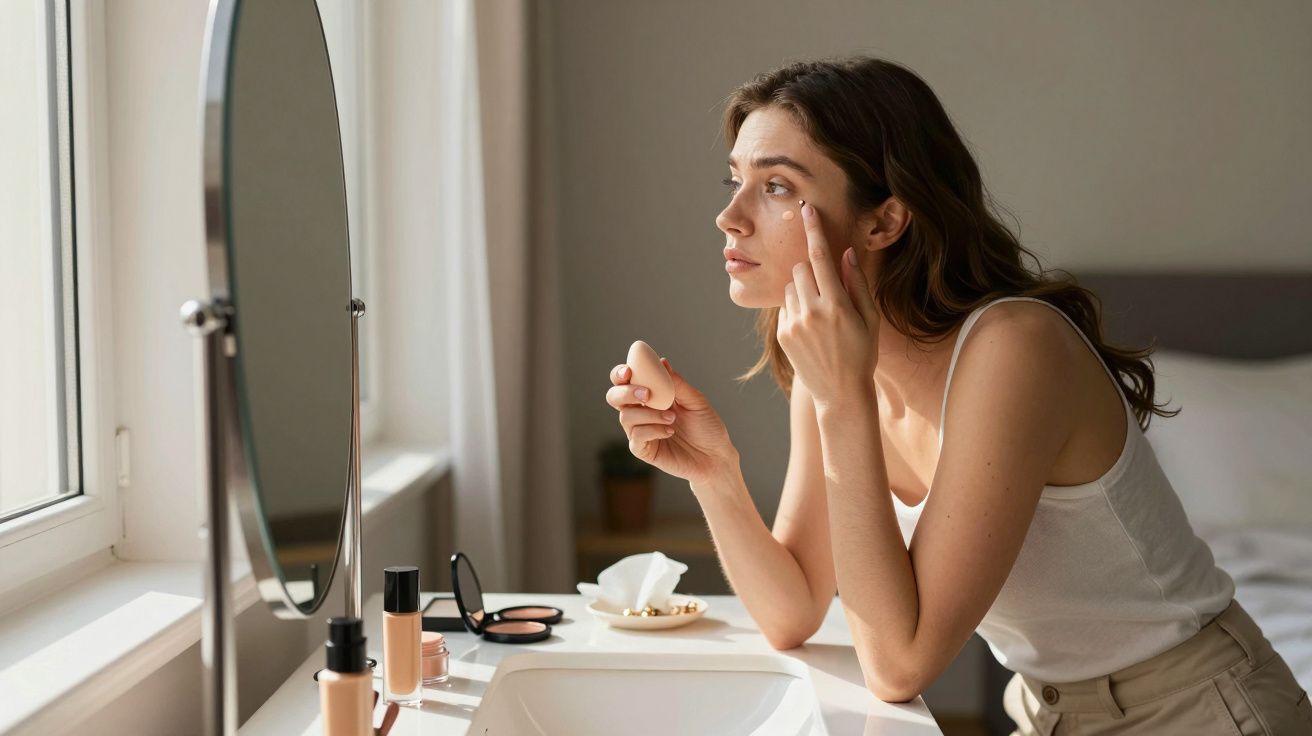
You can spot it across a room: the person in the lift lighting who looks “fresh” rather than “done”. Natural make-up is supposed to be that-skin, but better-yet it only works when precision blending is quietly flawless and nothing looks like it has been placed. That’s why the clean look can feel harder than glam: you have less product, less contrast, and nowhere to hide the edges.
Glam forgives a lot. A smoked-out liner can blur a wonky flick. A bold lip can distract from uneven base. Clean makeup asks for the opposite skill: control. You’re not building a look; you’re editing reality without leaving fingerprints.
The myth: “Clean” means quick
The clean-look brief sounds simple: sheer base, brushed brows, a wash of colour, go. In practice, the time goes into the parts no one compliments out loud-prep, texture, and transitions. If the finish is meant to mimic healthy skin, then anything that reads as product becomes the problem.
A full-beat face announces its structure. A clean face relies on micro-corrections: a touch of concealer that doesn’t sit on a dry patch, a blush that melts into the base, highlight that looks like hydration instead of shimmer.
The goal isn’t “no makeup”. It’s “no evidence”.
Why glam is easier to control
Glam uses deliberate contrast: deeper shadow, sharper line, brighter highlight. Those choices create clear borders, and borders are easier to execute. Even when they’re not perfect, they look intentional.
Clean makeup tries to avoid borders altogether. That means your tools and techniques need to be more precise, not less.
Glam has built-in camouflage
- Coverage hides texture (up to a point), so you can even out tone fast.
- Powder sets the story, locking the base in place.
- Strong colour placement tells the eye where to look, away from small mistakes.
- Defined shapes (liner, lip line, contour) read as “style”, not “error”.
Clean makeup can’t lean on those. If you powder heavily, it stops being clean. If you sculpt too much, it stops being effortless. And if you add shimmer to create interest, it can tip into “makeup-y” instantly.
Clean makeup is a lighting test you carry around
In a bathroom mirror, most complexions look cooperative. On the street, you meet side-lighting, office fluorescents, train carriage LEDs, and whatever your phone camera decides your pores look like today. Sheer products don’t cover mistakes; they emphasise them through shine and transparency.
The clean look also has a timing issue. Dewy finishes and creams can look perfect for twenty minutes and then start separating on the exact places you hoped would read as “glow”.
The three things that break the illusion
- Base clinging to texture (dryness, flakes, peach fuzz, congestion).
- Colour sitting on top (blush/bronzer that looks stamped rather than fused).
- Shine that’s uneven (greasy in the centre, flat on the perimeter).
Fixing those isn’t about buying a trend product. It’s about building a predictable canvas.
The real work happens before foundation
If clean makeup is the final exam, skincare is revision. That doesn’t mean a 12-step routine; it means choosing steps that stop makeup from catching and moving.
Think in outcomes: smooth enough for thin layers, hydrated enough for creams, grippy enough for longevity. If you skip this, you end up applying more product to solve a problem that started underneath.
A minimal prep that actually helps
- Gentle cleanse (or rinse) so you’re not applying over residue.
- Hydrate strategically: more on the outer face, less on the T-zone if you’re oily.
- Let it sit for a few minutes. Most pilling is impatience.
- Targeted primer only where needed (around nose, over texture), not everywhere.
If you want a shortcut, make it time. Five minutes of settling beats five extra layers later.
Precision blending: the non-negotiable skill
Precision blending doesn’t mean buffing everything until it disappears. It means placing small amounts exactly where they help, then softening only the perimeter so it looks like it belongs to your skin, not on your skin.
The clean look is built in thin films. Too much product at once forces you to move it around, and movement is what lifts base, exposes patches, and turns “dewy” into “slippery”.
Where precision matters most
- Under-eye concealer: keep it close to the inner corner and darkness, not down the cheek.
- Blush: apply higher and lighter than you think; blend the edge into the base, not over it.
- Cream bronzer: tap along the hairline and under cheekbone, then diffuse upward, not downwards.
- Highlight: choose sheen over sparkle; press onto high points, then step back.
A good rule: if you can see where you started blending, you’re not finished. If you’ve blended so much the colour is gone, you started with too little control.
Product choices that make “natural” easier
Clean makeup punishes the wrong texture. A matte full-coverage foundation can look heavy when applied sheer; a super-dewy tint can look sweaty when layered. You’re looking for formulas that behave well in small amounts.
A simple product stack that behaves
- Skin tint or light foundation with a natural finish (not ultra-matte, not wet-look).
- Spot concealer that sets without looking dry.
- Cream blush with a satin sheen, plus an optional powder blush to lock it in.
- Soft brow product (tinted gel or fine pencil) instead of a blocky pomade.
- Mascara that holds a curl without smudging-clean looks die by under-eye transfer.
If you want to add one “glam” trick, make it structure: a subtle tightline or individual lash clusters. They read natural at a distance, but they give the face definition so the base doesn’t have to.
A quick “clean look” checklist before you leave
Before you add more product, check the fundamentals. The fixes are often smaller than you think.
- Stand by a window and look for patches, not pores.
- Press (don’t rub) a tissue over the T-zone to remove surface oil without lifting base.
- Tap a tiny amount of concealer only where the eye goes first: around the nose, centre of chin, inner under-eye.
- If blush looks too strong, sheer it with your base brush, not more powder.
Clean makeup isn’t minimalist because it’s easy. It’s minimalist because it’s specific. The less you apply, the more every millimetre matters.




Comments (0)
No comments yet. Be the first to comment!
Leave a Comment