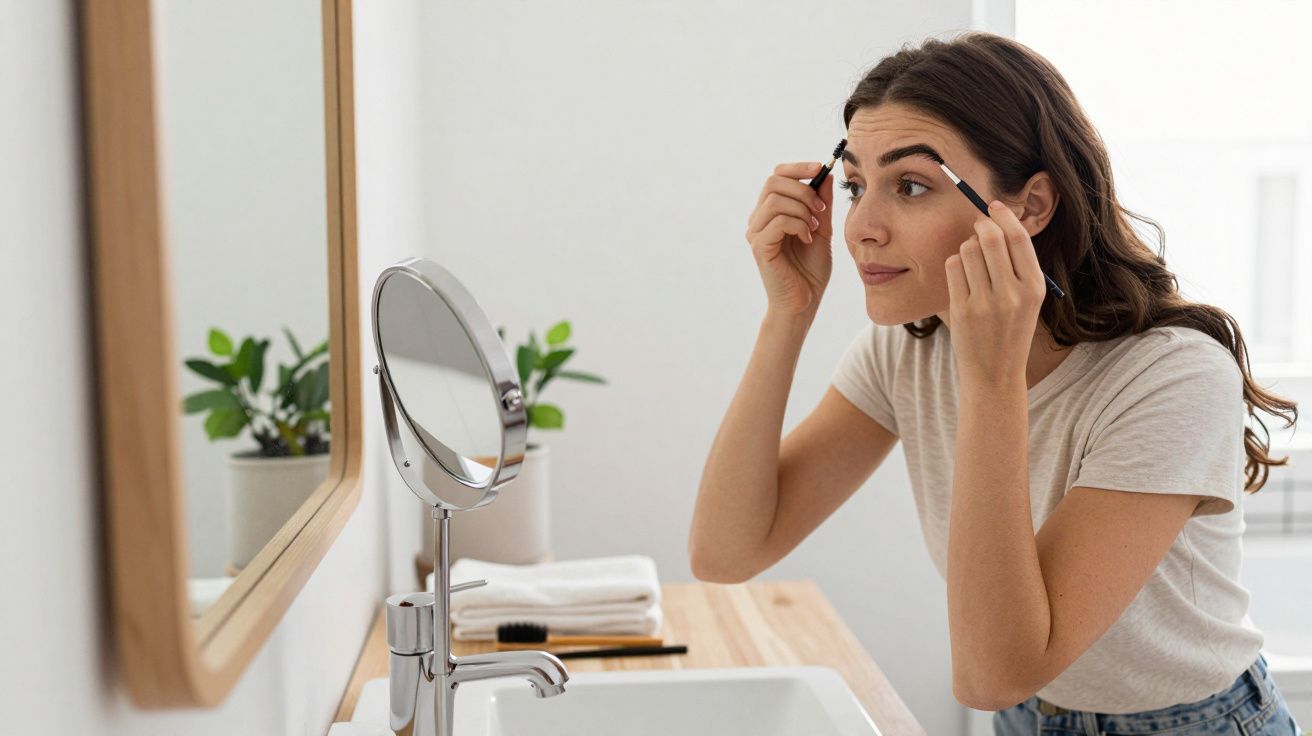
You book eyebrow shaping because you want symmetry: two clean, balanced arches that make your face look more awake. Then you get home, catch yourself in the car mirror, and one brow looks higher, heavier, or somehow… not like the other. Most of the time it’s not “bad work” so much as facial asymmetry showing up under sharper lines and brighter lighting.
It’s also a weird truth: the more polished your brows become, the more obvious tiny differences can feel. A soft, fluffy brow forgives. A crisp tail and a freshly mapped arch behaves like a highlighter pen.
The uncomfortable reason: your face isn’t mirrored
Brows sit on moving muscle, not on graph paper. One eyelid may sit a touch lower, one cheek may lift more when you smile, and one side may naturally “hold” more tension. When a technician shapes to your bone structure and hair growth, they’re working with two slightly different canvases.
That’s why you can leave an appointment with technically even brows-matched measurements, matched tails-and still see unevenness when you raise your eyebrows or talk. The shape is stable; the face underneath it isn’t.
A good professional often tries to balance this by leaving extra hair where the lower side needs visual lift, or by softening the stronger brow so it doesn’t dominate. But there’s only so far you can push hair to pretend the muscles underneath are identical.
Mapping can be perfect, but your hair growth may not cooperate
One brow often grows forward, the other grows down; one has a denser front, the other has a sparse mid. If you’ve ever noticed one side is “easier” to fill, that’s usually why.
After shaping, those differences can stand out more because:
- A denser brow reads lower and heavier, even if it’s the same height.
- A sparse tail looks shorter, so the brow appears to sit differently on the eye.
- A cowlick at the front can flare upwards, making one brow look taller.
You’re not imagining it. The hair pattern is doing a lot of visual work.
Swelling, redness, and lighting can make it look worse for 24–48 hours
Right after waxing, threading, or tweezing, the skin can puff slightly-often unevenly. If one side was more sensitive or had more hair removed, it may look more “lifted” or more bare.
Then there’s the lighting trap. Salon lighting is bright, frontal, and forgiving. Home lighting is often overhead and harsh, which throws shadows under one brow and not the other. The car mirror is the final boss: angled sun, brutal contrast, zero mercy.
If you want to judge the result fairly, wait until the next day, in neutral daylight, with a relaxed face. Not mid-commute, not mid-squint.
Your “everyday face” changes your brows more than you think
Most of us don’t hold our face evenly. You might raise one eyebrow when you concentrate, clench one side of your jaw, or sleep with your face pressed into a pillow on the same side every night. These habits subtly train muscles and skin to sit differently.
The result is that one brow can look:
- more arched when you’re animated
- flatter when you’re tired
- higher in photos taken from one side
This is where facial asymmetry stops being a theory and becomes your Tuesday.
Over-tweezing history and scarring can create permanent imbalance
If one brow has been “worked on” for years-plucked thinner in the 2010s, shaved at some point, over-waxed around the arch-it may not grow back with the same density. Even if both brows are shaped identically today, one brow simply has less to work with.
A pro can shape what’s there, but they can’t conjure hair from scar tissue. That’s why some people leave a shaping appointment feeling like one brow is always playing catch-up.
If this is you, a better goal is “balanced expression” rather than identical hair counts.
The tiny fixes that actually help (without spiralling)
The fastest way to stop chasing perfection is to choose one adjustment and stick to it for two weeks. Brows reward consistency, not panic-plucking.
A few options that work in real life:
- Fill the lighter brow first, then match the stronger brow with less product. Most people do the opposite and end up overbuilding.
- Brush both brows up and out, then trim only the very longest tips. Trimming can change perceived height more than tweezing.
- Ask for a “soft clean-up” next time, not a sharper carve. Crisp edges exaggerate differences.
- Use concealer sparingly under the lower brow only where needed, not a full under-brow stripe that makes height differences louder.
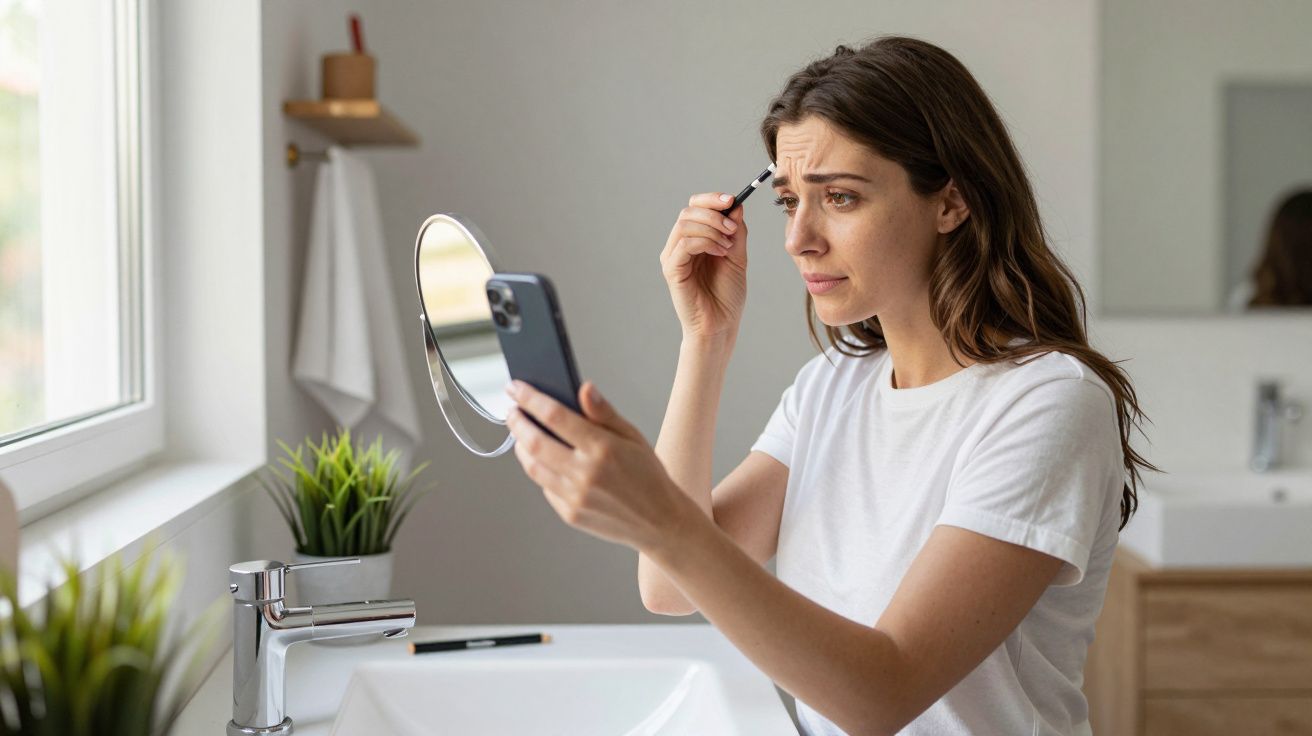
If you do tweeze at home, only remove obvious strays below the brow, and step back after every two hairs. The close-up mirror is not your friend.
What to ask for at your next appointment (so you leave happier)
Most technicians can adjust the plan in small ways if you give them a clear target. “Even” is vague. “This one looks heavier” is useful.
Try language like:
- “Can we keep the fronts a bit softer? They’re the bit that looks uneven on me.”
- “I’d rather match thickness than height.”
- “Please don’t chase the higher arch-can we lift the lower one visually instead?”
- “Can you show me the mirror with my face relaxed, not with brows raised?”
If you bring a photo, bring one that’s straight-on, neutral expression, in daylight. Not a filtered selfie with one side slightly closer to the camera.
When uneven brows are a sign to pause (not fix)
If one brow suddenly drops, or you notice a new, obvious change on one side-especially with headache, vision changes, or facial weakness-don’t treat it as a beauty problem. Seek medical advice.
For everyday unevenness, though, it’s usually just the combination of hair growth, muscle movement, and the harsh honesty of a freshly cleaned shape.
A well-shaped brow won’t erase asymmetry. It will make your face look intentional-which, in practice, is what most people mean when they say “even”.
| What you’re noticing | Likely cause | What helps |
|---|---|---|
| One brow looks higher in photos | Muscle pull / expression habit | Softer shape; fill lighter brow first |
| One brow looks heavier | Density difference | Reduce product on strong side; gentle trim |
| One tail looks shorter | Sparse growth or over-removal | Pencil tail lightly; avoid more removal |
FAQ:
- Why do my brows look uneven only after shaping? Sharper edges and cleaner tails make small differences in muscle position and hair density more noticeable. It’s often facial asymmetry becoming clearer, not a sudden new problem.
- Should a brow artist make them perfectly identical? They can make them more balanced, but truly identical brows are rarely realistic because the underlying bone, eyelid height, and muscle movement differ from side to side.
- How long should I wait before judging the result? Give it 24–48 hours if you’ve had waxing or threading. Minor swelling and redness can change how high or clean each brow looks.
- What’s the quickest way to make them look more even at home? Fill the lighter/sparser brow first, then use minimal product on the stronger brow. Overcorrecting the strong side usually makes the difference worse.
- Is it normal to have one brow that never behaves? Yes. A cowlick, different growth direction, or past over-tweezing can make one brow consistently more difficult. A softer shape and consistent maintenance usually beats aggressive re-shaping.


Comments (0)
No comments yet. Be the first to comment!
Leave a Comment