
At the salon, in the office lift, on the bus with your hands wrapped around a coffee cup, nail trends are one of the quickest ways to look “done” without saying a word. The 2026 shift is that the loudest sets-neon gels, maximalist charms, high-contrast art-don’t vanish because people stopped liking them, but because they stop fitting how we’re actually living. For readers, that matters because it changes what lasts in your diary, your budget, and your day-to-day maintenance.
On a grey Tuesday evening, I watched a woman pay for her groceries with two hands that looked like tiny billboards: chrome flames, 3D bows, a different colour on every nail. She held the card machine like she was holding her breath. When the receipt printed, she turned her fingertips inwards, almost protective, and walked out quickly, careful not to catch a charm on her coat cuff.
A week later, the same hands were back in the queue-shorter, softer, and quietly glossy. “I loved them,” she said, as if confessing. “But they didn’t love my life.”
What looks bold often comes with hidden friction
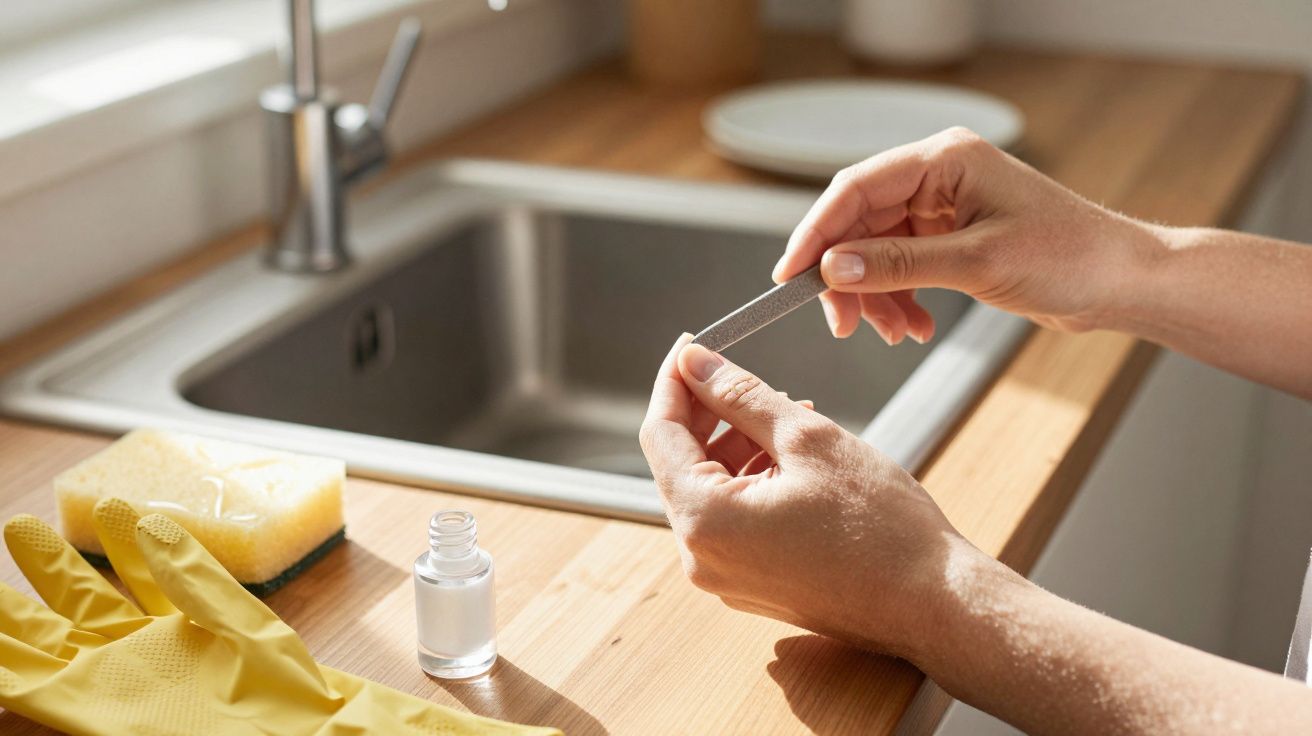
Bold nails don’t just take up visual space; they take up logistical space. The bigger the design, the more it interacts with everything: keyboards, gym grips, baby poppers, contact lenses, even the inside of a winter glove. That constant contact creates micro-lifts and chips that don’t show on a nude wash until they’ve become a proper break.
There’s also a timing problem. Maximalist sets need more appointments, more precision, and more careful aftercare. When you’re busy, stressed, or travelling, “careful” is the first thing that goes.
The result is not a sudden end to creativity. It’s a shrinking window of tolerance for anything that demands you behave like your hands are museum pieces.
The 2026 shift: less spectacle, more staying power
The mood isn’t anti-fun; it’s anti-faff. After years of statement everything-lashes, brows, nails, hair-the appetite moves towards styles that survive real life without constant correction. In nail terms, that means designs that keep looking intentional as they grow out, scuff, or get one tiny chip near the edge.
Think of it like a wardrobe change: the pieces aren’t less stylish, they’re more liveable. A sheer layer that hides regrowth reads “polished” for weeks; a crisp graphic tip can look messy by day four.
What replaces the bold set is often “quiet complexity”: tiny details you only notice up close, finishes that change in the light, and shapes that feel functional rather than performative.
Why bold nails disappear faster (even when people still want them)
A few forces stack up at once, and together they make maximalism feel less worth it.
- Maintenance economics: a detailed set costs more, and the cost is repeated if one nail goes. People aren’t only comparing prices; they’re comparing hassle.
- Hands are back to doing everything: more hybrid work, more commuting, more side hustles, more errands. Your nails are competing with straps, steering wheels, laptops, and train barriers.
- The “grown-out” look is less forgiven: bold art has a clear edge where it starts and ends. When it moves away from the cuticle, it looks like it’s sliding.
- Texture fatigue: 3D charms and heavy embellishments catch, scratch, and snag. Even when they’re secure, they ask you to be careful all day.
None of this means bold is “out”. It means bold has to earn its place by being wearable, not just photogenic.
The new sweet spot: designs that degrade gracefully
The sets that win in 2026 aren’t the quietest; they’re the ones that stay attractive as they age. The trick is to choose looks where growth and minor wear read as part of the design, not as failure.
Styles that last longer than they look like they should
- Sheer builder bases (milky pinks, syrups, soft beige): they blur regrowth and hide tiny chips.
- Micro-French and blurred tips: a thin, softened line keeps structure without shouting.
- “Aura” and diffused airbrush effects: because the centre is the feature, the edges don’t need to be perfect.
- Velvet and cat-eye finishes: movement distracts from small imperfections better than flat colour.
- Short, strong shapes (soft square, squoval): less leverage at the tip means fewer breaks.
The point isn’t to go boring. It’s to pick designs that don’t punish you for using your hands.
How to keep bold, without living at the salon
If you still love a loud moment-and many people do-there are ways to make it fit the new reality. Think “statement with boundaries”.
“Don’t rip out the personality,” a nail tech told me. “Just stop putting it on the part that gets hit first.”
A practical approach looks like this:
- Put detail near the cuticle, not the tip. Tips take the impact; cuticles stay protected.
- Choose one hero nail, not ten. Accent nails keep the vibe without multiplying the risk.
- Swap chunky 3D for flat illusion. Stickers, encapsulated glitter, and painted trompe-l’œil read bold but wear smoother.
- Ask for a flexible overlay. A good builder layer can make a bright design sturdier.
- Carry oil like you carry lip balm. Dry cuticles make everything look tired faster, even perfect colour.
Bold doesn’t have to disappear. It just has to stop acting like your week is built around it.
| What’s fading | What replaces it | Why it works |
|---|---|---|
| High-contrast, full-coverage art | Sheer bases with one focal detail | Grows out better, chips hide |
| Heavy charms and studs | Flat effects (chrome powder, cat-eye) | Less snagging, same drama |
| Extra-long shapes for impact | Short, sculpted shapes | Stronger tips, fewer breaks |
FAQ:
- Why do bold colours look worse when they chip? High pigment and high contrast make any missing edge obvious, especially on squared tips. Sheers and shimmers scatter the eye, so wear reads softer.
- Are nude nails “in” again, or is that just a backlash? It’s less a backlash than a practicality wave. The 2026 shift rewards styles that survive busy weeks, and nudes happen to be good at that.
- What’s the most low-maintenance way to keep a bold look? Go for a sheer base with a bold micro-tip or a single accent nail, and keep the length short. You’ll get impact with far fewer emergencies.
- Do press-ons solve the problem? Sometimes. They’re great for weekends and events, but if you’re hard on your hands, they can pop off at inconvenient moments. Think of them as “occasion nails”, not always-life nails.



Comments (0)
No comments yet. Be the first to comment!
Leave a Comment