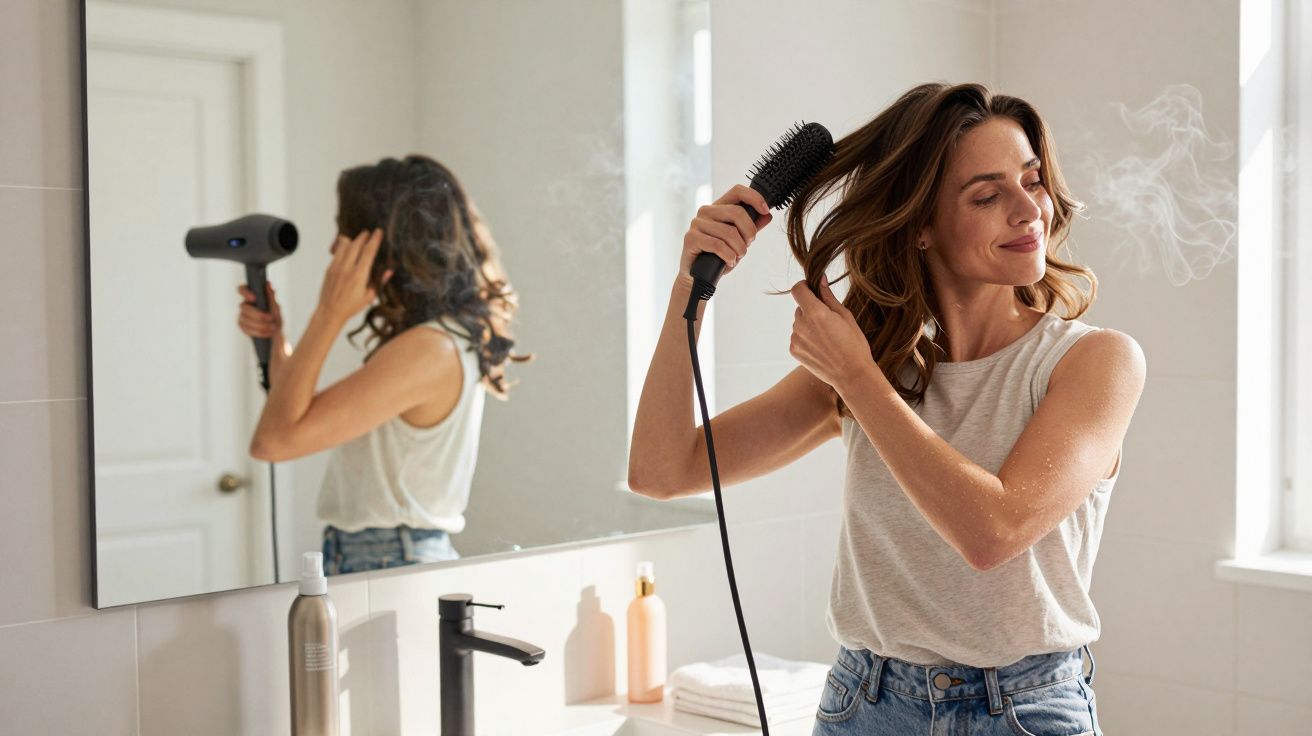
You step out of the salon or finish your own blow-dry styling at home, and for a brief moment it looks perfect: lift at the roots, bend at the ends, that smooth, bouncy swing. Then humidity hits on the walk to the car, or the office heating dries you out in a different way, and within an hour it’s as if your hair has “forgotten” what you just did. That collapse isn’t bad luck. It’s physics, product chemistry, and timing.
The frustrating part is how quiet it happens. No dramatic frizz explosion, just volume sinking, ends dropping, and a parting that gets wider by the minute.
What’s really holding a blow-dry in place
A blow-dry isn’t just “dry hair that’s been brushed nicely”. It’s a temporary reshaping of hair fibres while they’re warm and slightly damp, then “locking” that shape as they cool. Your brush creates tension and direction; the heat makes the hair flexible; the cooling phase sets it.
If any part of that chain is weak, the style doesn’t fail instantly. It gradually relaxes back to its default state, especially once the hair reabsorbs water from the air.
Think of the finish as a small engineered structure. It stands because the supports are there. Remove one support-cool-down, dryness, or grip-and it slumps.
The sneaky culprit: water, in and out of the hair
Hair is hygroscopic, meaning it readily takes on moisture. In humid air, it pulls in tiny amounts of water, and those water molecules interfere with the temporary bonds that were helping your blow-dry hold its shape. That’s why a style can look good indoors, then soften quickly outdoors or on a commute.
It also works the other way. If you blow-dry in a very dry environment and then move somewhere damp, you get a sudden “moisture shock”. The hair expands slightly, and your carefully made bends lose their crispness.
One detail most people miss: it’s not only about frizz. You can have smooth hair and still lose volume, because the roots relax first.
Why it collapses fast: the three most common causes
1) You’re not actually drying it enough
A finish can feel dry on the surface while the inner layers are still damp, especially at the roots and around the crown. That hidden moisture keeps the hair pliable, so gravity and movement win quickly.
A useful rule: if the hair feels cool to the touch after you stop drying, it’s often still damp. Truly dry hair tends to feel closer to room temperature.
2) The cool shot is skipped (or done too briefly)
Cooling isn’t a salon gimmick. The “set” happens as hair cools in the shape you created, and it needs a moment of stillness. If you blast hot air, then immediately drop the section and move on, you’ve made a lovely shape but never really set it.
This is why a blow-dry can look brilliant for photos right away, yet fall apart by the time you’ve reached your first coffee.
3) Product is fighting itself
Too much conditioning residue, heavy oils, or the wrong styling product can make hair overly slippery. Slippery hair is great for shine, but terrible for lift: the strands slide past each other, so the structure collapses.
On the other extreme, strong-hold products applied too wet can turn sticky and uneven. That can make you brush less thoroughly, leaving sections that never get proper tension and dry time.
The “invisible” factors people blame on technique
Some hair types are simply faster to relax. Fine hair loses volume easily because there’s less structural mass; very healthy hair with a smooth cuticle can be so silky it won’t grip a shape for long; and heavily bleached hair can hold shape well but react strongly to humidity (and look frizzier when it does).
Your cut matters, too. Long layers and heavy ends pull volume down. A blow-dry can temporarily defy that weight, but it’s still weight.
Then there’s touch. Running fingers through the roots, tucking behind ears, putting on scarves, leaning into a headrest-these actions are like repeatedly pressing down a spring.
How to make a blow-dry last longer (without turning it into a project)
You don’t need a new hair personality. You need a tighter “set”, less moisture, and more grip.
- Start with less residual slip: shampoo the roots properly, and don’t drag heavy conditioner up to the scalp.
- Use a hold product at the roots: mousse, root lift spray, or a light volumising lotion. Apply to damp, not dripping hair.
- Dry the roots first, deliberately: lift sections away from the scalp so the root area isn’t staying damp under the top layer.
- Build in cooling time: once a section looks finished, give it 5–10 seconds of cool air while it’s still on the brush.
- Let it settle before you leave: two minutes of “don’t touch it” after the blow-dry helps the set stabilise.
- If it’s humid, think barrier: a humidity-resistant spray or light hairspray as a final veil often beats adding more cream.
One small habit that makes a big difference: if you’re going outside, finish the blow-dry a few minutes earlier than you think you need to. The style that has cooled fully indoors survives the first hit of humidity far better than the one that’s still warm.
A quick diagnostic you can do in the mirror
If your blow-dry drops within an hour, look for the pattern. The pattern tells you the cause.
| What collapses first | Likely reason | Quick fix |
|---|---|---|
| Roots go flat, ends stay smooth | Roots not dry/set, too much slip | Dry roots longer; add root lift; cool-shot |
| Ends drop and straighten | Weight, not enough tension | Smaller sections; more brush tension; finish cooler |
| Whole style softens outdoors | Humidity rehydrating hair | Humidity shield spray; stronger final hold |
The take-home point
A blow-dry doesn’t “fail” because you did it wrong. It fails because it was never fully set, or because moisture and slip undid the temporary structure you built. Once you treat it like a set-and-seal process-dry, shape, cool, protect-an hour becomes a day much more often.
FAQ:
- Why does my blow-dry look great at home but collapse on the commute? The style is meeting humidity, wind, and friction (coat collars, headrests) before it has fully cooled and set. Finish earlier, cool-shot more, and use a light humidity-resistant finishing spray.
- Is hairspray the only solution for hold? No. Root lift mousse or spray under the blow-dry often gives longer-lasting structure than blasting hairspray at the end, especially for fine hair.
- Can I fix it without washing again? Often, yes. Re-lift the roots with a quick blast of heat and a round brush, then cool-shot. If the hair has absorbed moisture, a warm-air refresh plus a light finishing spray can restore shape.


Comments (0)
No comments yet. Be the first to comment!
Leave a Comment