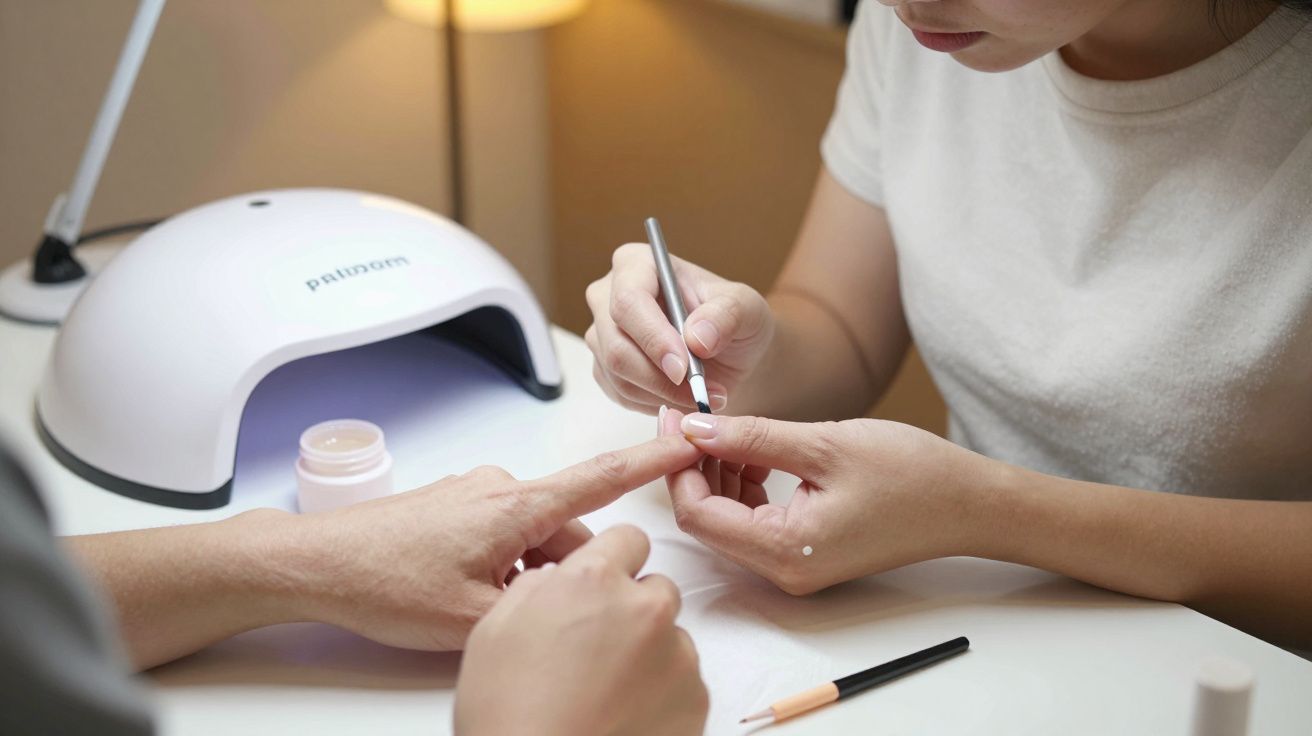
At the end of a long appointment, a client holds her hands under the lamp and frowns, not because the colour is wrong, but because something feels off. The set looks neat in the moment, yet she can already imagine the corners lifting by Thursday.
This is the quiet way biab nails fail when they’re applied too thin: the surface can look perfect while the builder gel structure underneath is too weak to do its job. If you wear your hands hard-typing, cleaning, opening boxes-thin BIAB doesn’t “wear in”. It fractures, lifts, and takes your natural nail with it.
BIAB isn’t just product - it’s architecture
BIAB is marketed like a friendly upgrade from gel polish: a little stronger, a little more protective, a little more “your nails but better”. That’s true only when it’s built like a support layer, not painted like a colour coat.
A proper builder gel structure relies on thickness in the right places. Not bulky, not bumpy, but enough mass to resist daily bending. When the nail flexes and the BIAB is too thin, the gel can’t absorb stress. It transfers it.
That’s when you see the classic “mystery issues”:
- small side-wall chips that grow into peeling
- hairline cracks across the apex area
- lifting at the free edge even though prep seemed fine
- soreness after a few days because the nail is flexing too much
People often blame the brand. More often, it’s physics.
What “too thin” really looks like on the nail
Too thin doesn’t always mean “flat”. You can have a tiny apex and still be too thin overall, especially at the stress points.
A thin BIAB application usually shows up as one (or more) of these patterns:
- The free edge is transparent and flimsy. The product hasn’t created a protective cap; it’s just tinted shine.
- The side walls are under-built. The nail can twist slightly, so the gel starts to separate where the nail moves most.
- The apex exists only in the centre. There’s a bump, but the surrounding area is paper-thin, so the bump becomes a hinge point.
- The surface looks “tight”. Clients describe it as feeling like cling film over the nail-hard, glossy, and oddly fragile.
In photos, thin BIAB can look elegant. In real life, it behaves like a brittle coating.
Why thin BIAB lifts: flex beats adhesion
Most lifting isn’t because the gel “didn’t stick”. It’s because it did, and then got forced to move in ways it wasn’t built for.
Natural nails flex. They flex when you press buttons, pull on jeans, scrub pans, or hook a shopping bag with your fingertips. A correctly built builder gel structure reduces that flex and spreads the load across the whole nail. A thin layer can’t.
So the nail bends, the gel resists, and the bond line takes the hit. Over time, microscopic separation becomes visible lifting-often starting at the sides or the free edge.
If you’re seeing recurring lifting on clients who swear they’re careful, ask a boring question before a dramatic one: Is the structure actually strong enough for their lifestyle?
Why thin BIAB cracks: stress concentrates in one spot
Cracks tend to appear where stress is concentrated: around the apex zone and just behind the free edge.
When BIAB is too thin, the nail behaves like a spring with a brittle shell. Each bend creates a tiny fatigue cycle in the gel. You might not see anything on day one. Then one morning there’s a faint white line, and by evening it’s a full split.
This is why “it was fine for a week” isn’t reassuring. Cracking is often delayed. It’s cumulative.
The common habits that create thin sets (even when you don’t mean to)
Thin BIAB is rarely intentional. It usually comes from practical salon habits and “tidy” instincts.
- Over-brushing during self-levelling. You keep smoothing until there’s nothing left to self-level.
- Fear of bulk. Especially on short nails, where any thickness feels obvious.
- Chasing a perfect side profile. You file the structure down until it’s pretty, not protective.
- Applying BIAB like gel polish. Two thin coats is a gel-polish mindset; BIAB needs a build layer.
- Underestimating the client’s nail length. Even short nails can need structure if they’re thin, bendy, or used as tools.
Let’s be honest: nobody builds every nail perfectly when the appointment is running late and the client keeps moving their hands. But structure is the part you can’t bargain with.
How to tell if the builder gel structure is doing its job
You don’t need a ruler. You need a quick mental checklist that focuses on stress points rather than overall thickness.
Look for:
- Apex placement that suits the nail length (not always dead-centre; often slightly back from the middle)
- Even support from cuticle to free edge, without “thin valleys” around the apex
- Reinforced side walls, especially on clients who type, lift, or clean a lot
- A properly capped free edge, so the tip isn’t the first place to break the seal
If the nail still visibly flexes when the client presses lightly on a hard surface, the set is probably under-built for them.
The fix isn’t “thicker everywhere” - it’s thicker where it matters
Over-building creates its own problems: heat spikes, bulk, awkward regrowth, and that heavy feeling clients hate. The goal is controlled structure.
A practical way to think about it is “support zones”:
- Cuticle area: thin and flush so it can grow out neatly
- Apex/stress area: strongest point, smooth transition (no lump)
- Free edge: sealed and supported so impact doesn’t start lifting
If you’re a client, the takeaway is simple: if your BIAB always fails early, it may not be your nails “not suiting BIAB”. It may be that you’re wearing a support product without the support.
| What you notice | Likely cause | What usually helps |
|---|---|---|
| Lifting at side walls | Nail twisting/flexing | Better side-wall support and apex balance |
| Cracks across the middle | Stress concentration | Stronger build in the stress zone |
| Free-edge peeling | Tip not sealed/supported | Capping and enough structure near the edge |
FAQ:
- Is thin BIAB better for weak nails? Not usually. Weak, bendy nails often need more correct structure so the nail doesn’t flex and break the bond.
- Can I just “do better prep” to stop lifting on thin BIAB? Prep matters, but it can’t compensate for a builder gel structure that’s too weak for daily stress.
- Why do my BIAB nails look fine but crack later? Fatigue. Repeated tiny bends create micro-cracks that become visible after several days.
- Does longer nail length require more structure? Almost always. The longer the lever, the more force the product has to resist.
- Will making it thicker stop all breakages? Only if the thickness is placed correctly. Bulk without structure can still crack and can feel uncomfortable.




Comments (0)
No comments yet. Be the first to comment!
Leave a Comment