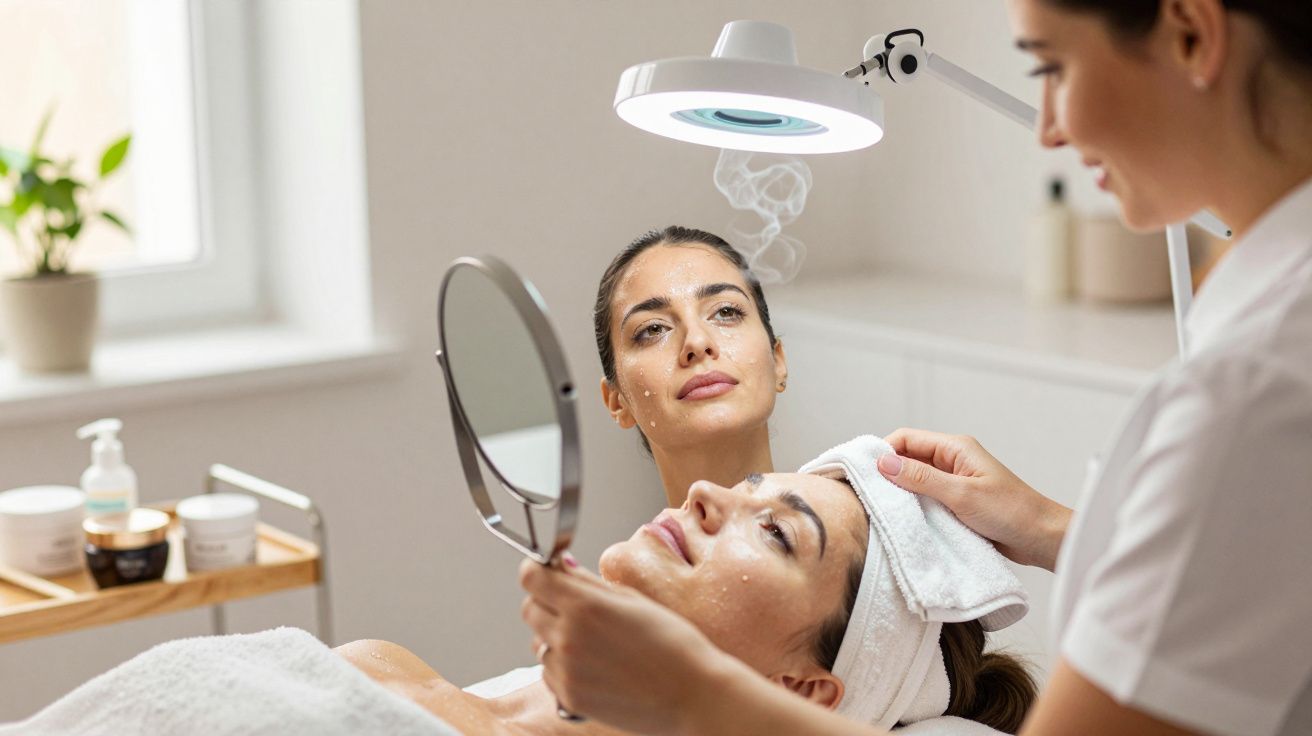
A beauty experience can look like pure surface - a facial at a salon, a brow tidy in a small chair by the window, a manicure squeezed into a lunch break - yet it can tug hard at self-perception. You arrive for polish or “maintenance” and leave with a tight throat, a sudden lightness, or the odd urge to cry on the way home. That reaction isn’t you being dramatic; it’s your nervous system registering care, scrutiny, and change all at once.
At 5:18 p.m., the treatment room is all soft noises: the pump of cleanser, the click of a lamp hinge, the therapist’s calm “How does that feel?” You lie still while someone touches your face with confidence, and your brain starts doing what it always does when the mirror is involved - keeping score. Not just of pores or pigment, but of how you’ve been living.
The emotional switch hiding in the smallest details
What flips the switch is rarely the treatment itself. It’s the combination: close attention, physical touch, and a visible “before and after” that lands directly on identity. Your skin is both a boundary and a billboard; when it’s handled, you feel seen, and when it changes, you feel changed.
There’s also something quietly intense about being cared for by a near-stranger. You’re asked to relax while someone looks closely at you under a bright light, naming things you normally avoid naming: dehydration, congestion, redness, tension in your jaw. That can feel like relief - finally, someone can help - or like judgement, even when no judgement is intended.
Think of it as the mirror effect with the volume turned up. A tint, a wax, a peel, a fresh set of lashes: these are small edits that can amplify how you interpret yourself. If self-perception has been wobbling lately, the wobble gets louder in a room built for noticing.
What your body is doing while you’re “just having a treatment”
There’s a simple claim hiding here: emotions rise because your body reads the moment as important. Touch can shift your chemistry in minutes, nudging you towards calm, or sometimes releasing what you’ve been holding in. A treatment is a sensory intervention, not just a cosmetic one.
Here’s the plausible chain, in plain terms. You lie down; your breathing slows; warm towels and steady strokes cue parasympathetic tone. Then the mind joins in: I’m allowed to rest meets someone is evaluating my face meets I’m about to look different. That cocktail is powerful, especially if you’ve been running on low sleep, high stress, or quiet self-criticism.
And sometimes it’s grief in disguise. Not always big, cinematic grief - but the small kind: how long you’ve felt “not quite right”, how hard you’ve been on yourself, how much effort you put into being presentable for other people. The body often chooses safe, contained moments to let that out.
“It wasn’t the facial,” a friend once said. “It was the first time in weeks someone touched my face gently.”
The three moments that tend to trigger big feelings
Most emotional spikes happen in one of these windows, because each one hits self-perception in a different way:
- The consultation: you have to describe what you dislike, out loud, to another human. That can feel exposing, even if you’re being practical.
- The in-between: when you’re covered in product, eyes closed, not able to perform. It’s rare, enforced stillness - and feelings like stillness.
- The reveal: the mirror moment. Even a good result can land strangely if it clashes with how you expect to look, or if it highlights how harshly you’ve been viewing yourself.
If you’ve ever felt emotional after a haircut, it’s the same mechanism. You’re not only seeing hair; you’re seeing a version of yourself that time and stress have been editing without your permission.
How to make the experience feel safer (without numbing it)
You don’t need to “power through” a beauty appointment like it’s a test. A few small choices can keep the experience supportive, especially when you know you’re fragile.
Try a micro-ritual before you go in. Decide what the appointment is for today: maintenance, recovery, confidence, or comfort. One word. It gives your mind a lane to stay in when the mirror tries to start an argument.
Then use simple, specific communication. Not a speech - just a sentence that sets the tone:
- “I’m feeling a bit sensitive today; gentle feedback only, please.”
- “I’m working on my skin without criticising it - can we keep language neutral?”
- “If you think something needs addressing, I’d rather hear options than flaws.”
If the reveal hits you unexpectedly, slow it down. Ask to see it in softer light, or look at one feature at a time rather than scanning for “what’s wrong”. Your brain does better with a single point of focus than a full-face audit.
Why the feelings can be a good sign, actually
Emotional doesn’t always mean bad. Sometimes a beauty experience becomes a rare moment where care is non-productive: you’re not achieving, fixing, or proving - you’re receiving. For people who live in their heads, that can be unfamiliar enough to feel like tears.
Other times, the feeling is information. If you feel shame, you might be carrying a story about what you’re “allowed” to look like. If you feel relief, you might be realising how starved you’ve been for softness. If you feel anger, it might be about time, money, pressure, or the sense that your face has become a project.
None of this means you should stop doing treatments. It means you can treat the reaction as part of the service: a check-in on self-perception, not just a polish on the surface.
| Moment | What it touches | What helps |
|---|---|---|
| Consultation | Naming insecurities | Neutral language, clear options |
| Treatment stillness | Nervous-system release | Slow breathing, permission to feel |
| Mirror reveal | Identity + expectation | Softer light, focus on one detail |
FAQ:
- Why do I feel like crying after a facial or massage? Your body may be dropping out of stress mode, and touch plus stillness can release held tension. The mirror moment can also hit self-perception more deeply than you expect.
- Is it normal to feel worse about my looks after a treatment? Yes, especially if you’re swollen, red, or simply hyper-aware. Give it a day, and avoid “magnifying mirror thinking” right after.
- Should I tell the therapist if I’m feeling emotional? If you can, yes. A simple “I’m a bit teary today” helps them adjust pace, language, and pressure without making it a big thing.
- How do I avoid spiralling in the mirror afterwards? Look for what feels comfortable (skin texture, brows sitting evenly, shoulders relaxing) rather than hunting flaws. One minute, then stop.
- Does this mean I’m too dependent on beauty treatments? Not necessarily. It may mean the appointment is one of the few places you receive focused care - and that’s worth noticing and balancing elsewhere too.



Comments (0)
No comments yet. Be the first to comment!
Leave a Comment