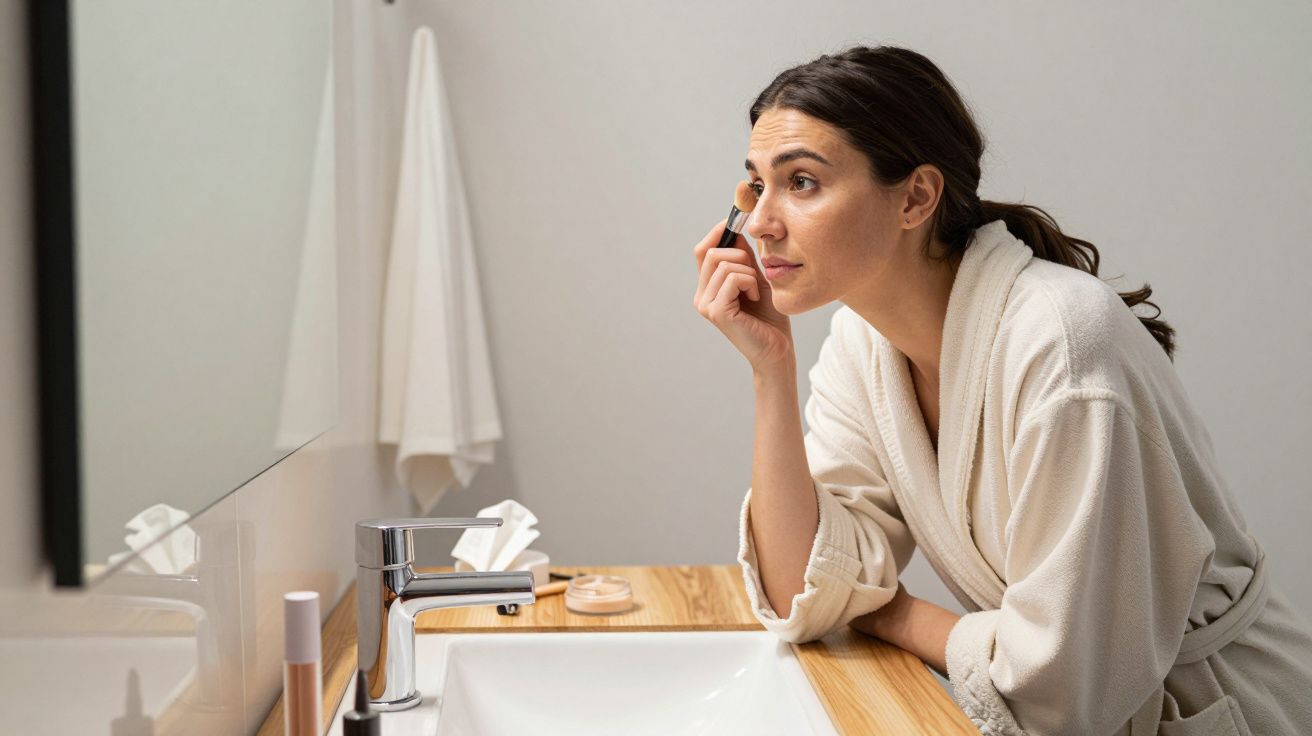
Make-up application has a strange little failure mode that always seems to happen right when you leave the house: you catch your reflection and the base has folded itself into tiny lines. You blame your concealer, your primer, your setting powder - but most of the time the real culprit is skin texture and what’s happening underneath the makeup, minute by minute, as your face moves. If you understand that, you stop chasing “crease-proof” miracles and start making small changes that actually hold up.
It usually hits in the same places: under the eyes, around the mouth, between the brows, on the sides of the nose. Areas that blink, smile, scrunch, and get touched. Makeup doesn’t fail there because it’s bad - it fails because it’s doing physics on top of living skin.
The real cause: your makeup is sitting on a moving, thirsty surface
Creasing isn’t a moral failing or a skill issue. It’s what happens when product settles into the tiny folds that were already there, then gets nudged deeper every time you talk, laugh, or squint. Add a bit of oil and a bit of dehydration, and the film of makeup starts to separate like paint on a flexing wall.
There’s a boring truth that fixes a lot of frustration: most creasing is a texture-and-balance problem, not a product problem. If your skin texture is uneven (dry patches, fine lines, flaking, enlarged pores), makeup clings to the edges and sinks into the gaps. If your base is too wet, it slides; if it’s too dry, it cracks. Either way, the line becomes a little storage trench.
The under-eye is a crease factory (and it’s not because you’re “getting older”)
Under-eyes move constantly. Even when your face looks still, you’re blinking, micro-squinting at a screen, tensing when you concentrate. On top of that, the area tends to be drier and thinner, so it shows texture quickly and doesn’t “melt” product into place the way cheeks sometimes can.
A lot of people try to fix this by adding more - more concealer, more powder, more setting spray. That often makes it worse. You end up with a thicker layer that has more material to fold.
The sneaky chain reaction: too much product, too close to the crease
If there’s one pattern behind most creasing complaints, it’s this: the product is applied right where the skin folds, then it’s set too aggressively or not set at all, and the face does what faces do.
You see it most clearly with concealer. People paint it from lash line to cheek, then wonder why it bunches. But concealer doesn’t need to live in the crease to brighten the area - it needs to live around it and be blended up to it.
Here are the common tripwires that turn “fresh” into “folded”:
- Applying a thick layer in high-movement zones (under-eye trough, smile lines).
- Mixing incompatible layers (very rich skincare + silicone primer + matte base) so the film slips.
- Setting with too much powder, which grips and then cracks as the skin flexes.
- Skipping hydration, which makes texture look louder and encourages patchy settling.
- Rubbing or tapping throughout the day, pushing product into lines like you’re ironing it the wrong way.
A more reliable fix: prep for your texture, then apply less than you think
The goal isn’t to erase skin texture. It’s to stop emphasising it. That means your routine needs to match what your skin is doing right now, not what it did in summer or what it does on a “good skin day”.
1) Treat “dry” and “dehydrated” like different problems
Dry skin lacks oil; dehydrated skin lacks water. You can be oily and dehydrated at the same time, which is why some people crease and shine.
A simple, workable approach before makeup:
- If you flake: use a gentle, fragrance-free moisturiser and give it time to settle.
- If you’re dehydrated: add a hydrating layer (something humectant-heavy) and seal lightly.
- If you’re oily: keep skincare thin, then use targeted powder later - not a blanket dusting.
Let your skincare sit. Most base products crease faster when they’re applied onto a moisturiser that’s still shiny and wet, because nothing has anchored yet.
2) Place product where it helps, not where it folds
Under-eye concealer works better when it’s strategic. Dot it slightly lower than the lash line, blend up, and keep the thinnest layer right at the crease. Then stop touching it for a moment - give it 30–60 seconds to settle before you set.
For smile lines, the move is similar: keep foundation thin around the mouth, and do your coverage on the cheeks and jaw instead. The eye reads the whole face as even when the high-coverage areas are smooth.
3) Set in a way that matches movement
Powder isn’t the villain. The amount and placement are.
If you crease under the eyes, try this: set only the inner corner and the very bottom edge where you placed concealer, then leave the direct fold area almost bare. You’re building a lightweight “frame” rather than creating a stiff cast.
A good rule is: set where you want longevity, not where you want flexibility.
The quick “crease reset” you can do in a mirror (without adding more)
When you spot creasing, the instinct is to pile on powder. That usually locks the crease in.
Instead:
- Use a clean fingertip or a small brush to gently press and smooth the line out.
- If it looks dry, tap the tiniest amount of moisturiser or eye cream on the back of your hand, then pick up a whisper of it and press over the area.
- If it looks shiny, use a tissue to blot, then tap a pinhead of powder just on the edges.
The point is to correct the surface, not build a new layer on top of the problem.
What creasing is really telling you (and why that’s useful)
When makeup creases, it’s usually your face saying one of three things: the skin is thirsty, the layer is too thick, or the area is moving more than your base can flex with. That’s not bad news - it’s diagnostic.
Once you start treating skin texture as part of the canvas rather than something to “cover into submission”, everything gets easier. Your base looks more like skin, your touch-ups get smaller, and you stop spending money on products that promise to defy anatomy.
A simple checklist for tomorrow morning
- Keep skincare thin and give it time to settle.
- Apply less base in high-movement zones.
- Blend strategically: coverage around creases, not inside them.
- Set lightly and locally.
- Touch up by smoothing first, adding product second.
FAQ:
- Why does my make-up crease even with primer? Primer can help grip or smooth, but it can’t stop skin from moving. If the layer on top is too thick, too dry, or sitting on pronounced skin texture, it will still fold into lines.
- Is powder causing my creases? Too much powder often makes creases look sharper because it stiffens the surface and emphasises dryness. Light, targeted setting usually works better than heavy baking.
- Do I need a different foundation for textured skin? Sometimes, but technique matters more. A thin layer applied thoughtfully often outperforms a “full coverage” formula that’s prone to building up and settling.
- How do I stop under-eye concealer creasing? Use less than you think, keep the thinnest layer right at the fold, let it settle briefly, then set only where needed rather than blanketing the whole under-eye in powder.



Comments (0)
No comments yet. Be the first to comment!
Leave a Comment