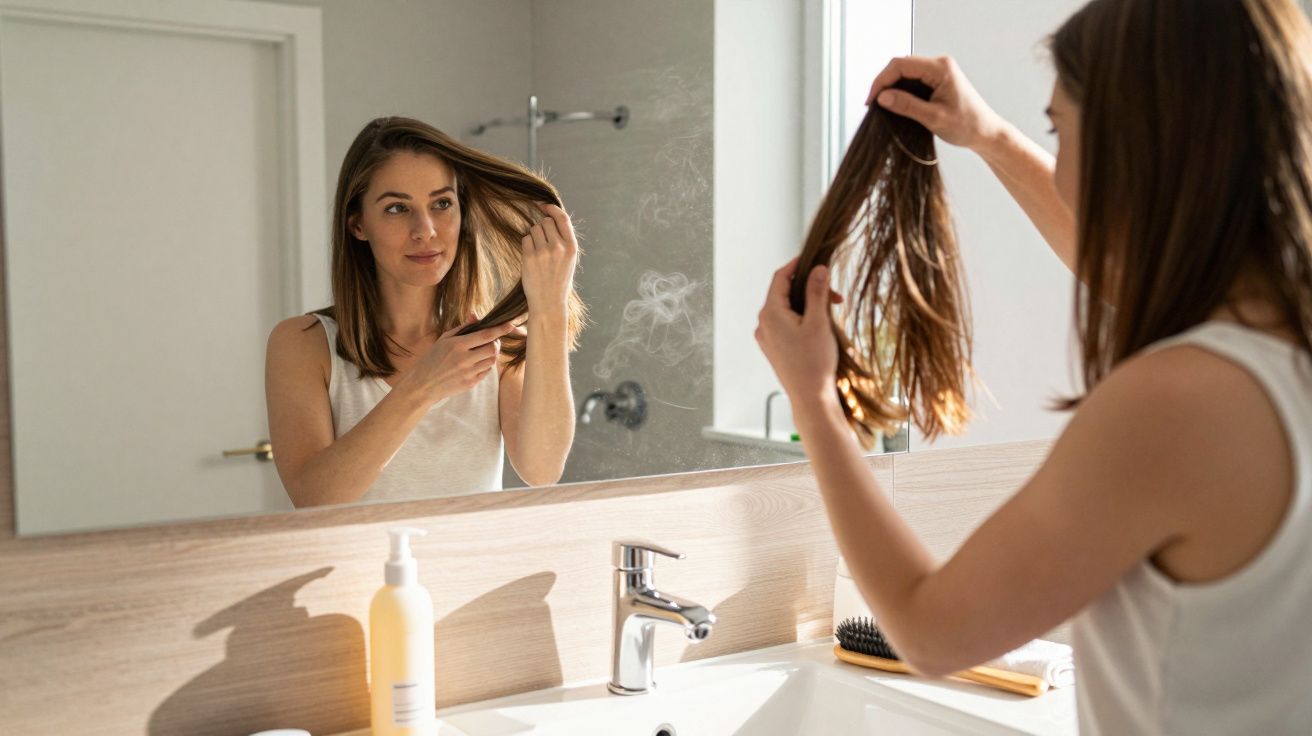
Hair styling is supposed to give you lift, not erase it, yet one tiny habit can undo all your work: not noticing product weight as you apply your prep and finishers. It shows up at the mirror as “mystery flatness” - roots that collapse by lunchtime and lengths that cling together instead of looking airy. The fix isn’t a new tool; it’s getting ruthless about where your product goes and how much hair you’re asking it to carry.
I first clock it on damp hair, when everything feels manageable and “just a bit more” seems harmless. Then it dries, the texture tightens, and volume disappears like it was never there.
The mistake: coating the roots like they’re lengths
Most people apply styling cream, oil, smoothing serum, or even a rich leave-in from crown to ends, then wonder why the top has no spring. Your roots are the scaffolding. If you wrap them in heavy slip, they lose friction against each other, so they stop standing up and start lying down.
Think of it as a physics problem in the bathroom: product weight plus gravity, minus texture, equals flat. The more fine your hair is, the faster that equation wins.
Volume isn’t just “more heat”. It’s clean lift at the base, and that demands less weight, not more.
Why it happens (even with “volumising” products)
Labels can be misleading because “volumising” often means the finish looks thicker, not that the formula is actually light. Some mousses are airy but sticky; some sprays are light but build up; some “hydrating” primers are excellent - for ends - and disastrous at the scalp.
A few common ways you accidentally overdo it:
- You use the same amount regardless of hair density (fine hair needs far less).
- You apply product on soaking wet hair and it travels up to the root line.
- You layer multiple products that all contain oils, silicones, or polymers.
- You “top up” on day two without resetting with a wash or a proper brush-through.
The result is a root area that behaves like it’s slightly damp, even when it’s dry: heavy, shiny in the wrong places, and quick to separate into stringy sections.
A quick self-check: is your volume being crushed or missing?
Before you change your whole routine, do a 30‑second audit. Stand under good light and look at the first 5 cm from your scalp.
- If the root area looks shiny and feels slick, you’re dealing with excess weight.
- If it feels gritty and stiff, you’ve got build-up or too much dry texture product.
- If it feels clean but still lies flat, you may need better direction when blow-drying (lift and airflow), not more product.
The point is to diagnose honestly. Flat hair from weight needs subtraction, not another “boost”.
The fix: treat roots and ends as two different zones
Split your head into “support” (roots) and “finish” (mid-lengths to ends). Then apply like you mean it.
Step-by-step reset (works for blow-drying or air-drying)
- Start lighter than you think. Use a pea-sized amount of cream or leave-in for fine hair; a 10p-sized amount for thicker hair.
- Apply to ends first. Warm product between palms, then rake through mid-lengths and ends only.
- Keep a 2–3 cm buffer from the scalp. If you need frizz control near the top, touch just the halo and only with what’s left on your hands.
- Add lift at the base with a root-only product. Use a true root spray/foam and aim under sections, not over the top.
- Dry with intention. Lift the roots away from the scalp (fingers or brush), directing airflow up and back before you smooth anything down.
If you’re a serial over-applier, decant your product into a smaller pump bottle. It forces a better dose without willpower.
Product weight: the usual culprits (and smarter swaps)
Some products are brilliant - just in the wrong place. Here’s a practical guide for everyday routines:
- Oils and gloss serums: keep for ends only; use 1–2 drops, not a puddle.
- Rich leave-ins and masks-as-leave-in: swap to a lightweight spray conditioner if you need slip.
- Heavy “anti-frizz” creams: use a tiny amount on the outer layer, then brush through to distribute.
- Dry shampoo: great for lift, but if you layer it daily it can create a dull, heavy root cast; cleanse properly every few days.
If your hair is fine and you love shine, pick shine that rinses (light sprays) rather than shine that coats (oils at the scalp). The best volume often looks slightly less “perfect” up close and far better from a normal distance.
A two-day plan to get your volume back
You don’t need a dramatic overhaul; you need a clean baseline and a controlled re-introduction.
- Day 1: Clarify (or double-shampoo), condition only mid-lengths to ends, then style with one product plus a root lifter.
- Day 2: Refresh with airflow (quick blast at the roots) and a small amount of dry shampoo, then brush and re-lift. Skip oils near the face; tap a micro amount into ends only.
Within a week, you’ll know if weight was the real issue, because the improvement is immediate: roots feel “grippy” again, and styles hold their shape longer.
Quick comparison guide
| Hair situation | What to stop | What to do instead |
|---|---|---|
| Fine hair falling flat by noon | Cream/serum at roots | Root spray + product on ends only |
| Frizzy top layer but flat crown | Adding more smoothing product | Tiny halo-only amount + lift while drying |
| Greasy-but-dry look | Layering dry shampoo + oil | Proper cleanse + lightweight ends mist |
FAQ:
- Can I ever use oil near the scalp? Rarely, and only in tiny amounts for specific styles (sleek buns, braids). For everyday volume, keep oils off the root zone.
- Is it better to apply product on wet or damp hair? Damp is safer for volume because you control placement; on soaking wet hair, product can migrate to the roots and add weight where you don’t want it.
- What if my hair is thick and still goes flat? Thickness doesn’t always equal lift. You may still be over-coating the root area, or blow-drying without lifting sections away from the scalp.
- How do I know if it’s build-up rather than too much product today? If your hair feels coated even after washing, looks dull at the root, or resists volume no matter what, clarify once and reassess with a lighter routine.



Comments (0)
No comments yet. Be the first to comment!
Leave a Comment