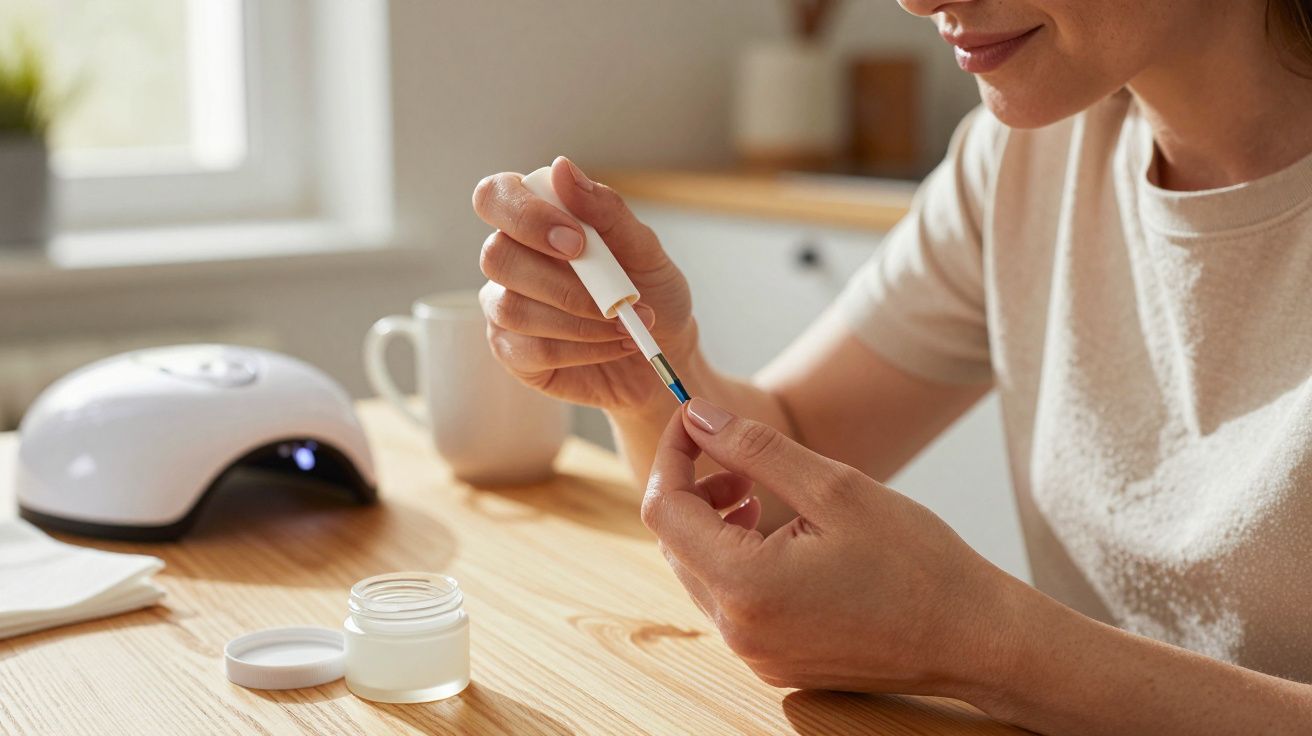
The difference between biab nails that look intact at day 14 and biab nails that still feel “new” at week four is rarely your lamp, your brand, or your patience. It’s builder gel thickness-how much product you leave on the nail in the apex zone versus how thin you keep it at the edges-and it’s decided in minutes, quietly, during application. If you’ve ever had lifting at the sides with a nail that still feels hard in the middle, you’ve already met the problem.
In salon terms, BIAB is sold as strength you can live in: a flexible, supportive overlay that moves with natural nails and grows out neatly. In real life, longevity is a physics problem disguised as beauty. The nail plate bends, water swells it, knocks twist it, and your gel either distributes that stress-or concentrates it into the weakest point until it pops.
The detail most people miss: “thicker” isn’t the goal, strategic thickness is
There’s a moment in a BIAB service where everything looks fine: coverage is even, the colour is smooth, the surface is glossy. And yet the nail is already set up to fail, because the bulk is in the wrong place.
Builder gel thickness matters in three zones:
- The apex (stress area): needs enough structure to resist bending.
- The sidewalls and cuticle area: must stay thin so the gel can flex and bond without peeling.
- The free edge: needs a sealed, supported transition, not a heavy ridge.
When people hear “apex”, they imagine a hill. What you actually want is a gentle ramp: subtle, centred, and placed where the nail naturally takes impact (usually slightly past the centre, toward the free edge). Too far back and you get leverage at the tip. Too far forward and the middle becomes a stiff plank that pries at the cuticle line.
Why lifting starts at the edges, even when the middle feels rock-solid
Lifting is rarely a “weak gel” problem. It’s usually a stress-and-adhesion problem.
If the product is left too thick around the cuticle or along sidewalls, it cures into a stiff ledge. Daily flexing then turns that ledge into a tiny pry bar. Water, oils, and micro-gaps move in. The edge lifts first because it’s where the nail bends most and where your prep has the least forgiveness.
On the flip side, if the apex is too thin, the nail flexes like a diving board. The gel may stay bonded for a while, but the repeated movement concentrates stress at the same perimeter. Two weeks later, you see that familiar “smile” of lifting at one corner.
The goal isn’t to make every part equally thick. The goal is to make stress travel through the nail without stopping at the perimeter.
A practical way to check your thickness without fancy tools
You don’t need calipers. You need a repeatable checkpoint before you cure.
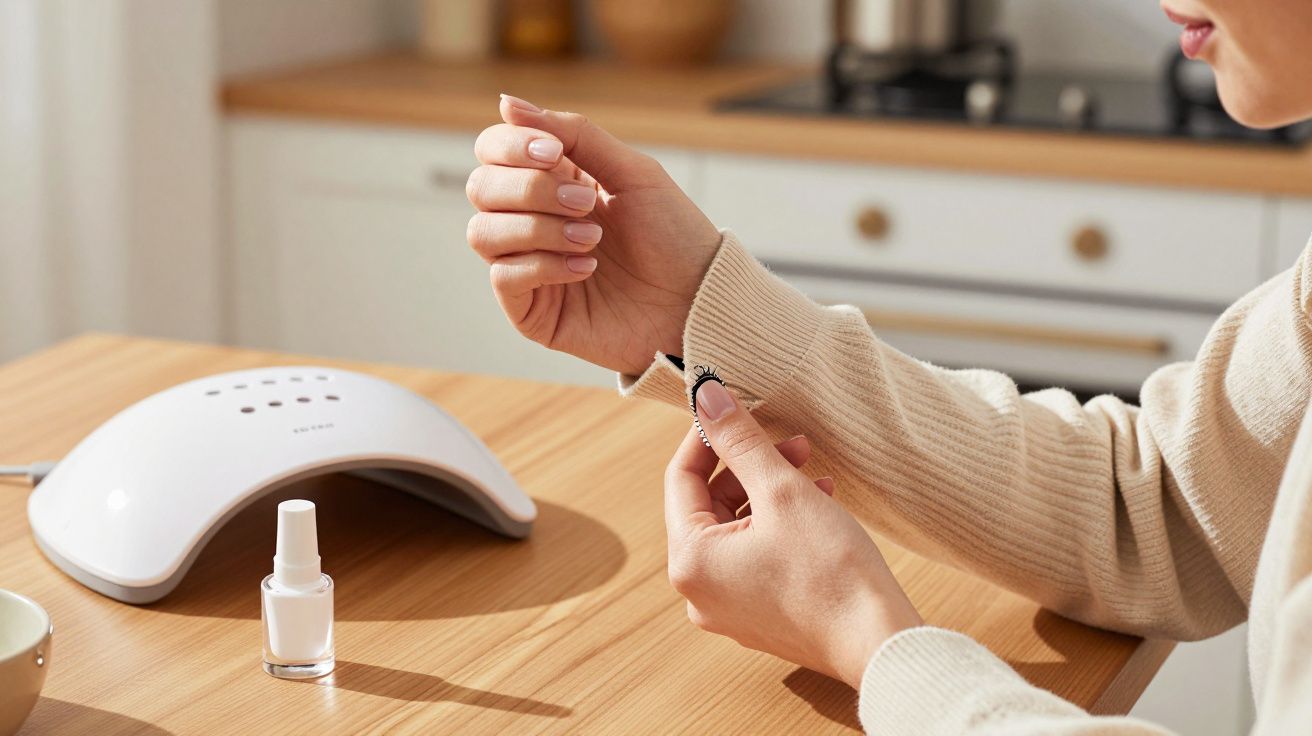
- Side profile check: hold the finger at eye level and look across the nail. You should see a smooth rise and fall, not a flat plateau or a sudden bump.
- Light reflection check: the highlight line should be continuous and slightly curved. If it breaks or zigzags near the cuticle, you’re too thick or uneven there.
- Cuticle “shadow” check: there should be no visible ridge where product pools at the base. If you can see a ledge, it will catch hair, then lift.
- Free edge check: flip the hand and look from underneath. If you see a bulky lip, file it back-bulk at the edge doesn’t equal strength.
A useful mental model is this: thin where the nail needs to move, thicker where the nail needs support. Most chipping and lifting comes from reversing those.
How to build it: one controlled bead, then a clean perimeter
If your BIAB is self-levelling (most are), your brushwork should be less “painting” and more “placing”.
- Start with a thin slip layer (a very light coat you do not cure yet, unless your system requires). This gives the bead something to glide on instead of grabbing.
- Place a small bead in the stress area and let it settle. Tilt the finger slightly if needed, but don’t chase it endlessly.
- Use the tip of the brush to float product towards the sidewalls without flooding them. The brush should skim, not press.
- Keep the cuticle zone intentionally thin. If you’ve pushed product close, lightly pull it back before curing.
- Cure, then refine with a file only where necessary: shape first, perimeter second, never the other way round.
Soyons honnêtes: the temptation is to fix every tiny imperfection by adding more gel. That’s how thickness creeps into the wrong places. The better habit is to place less, let it level, and correct with minimal filing.
Fast symptoms: what your wear pattern is telling you
Your nails usually report the problem clearly, if you read the location.
| What you see | Likely cause | What to change next time |
|---|---|---|
| Lifting at sidewalls by week 2 | Perimeter too thick or flooded | Thinner sidewalls; cleaner cuticle line |
| Breaks at the free edge | Apex too thin or too far back | Build support slightly forward |
| Hair catching at the cuticle | Ridge at the base | Pull product back before curing; refine thinly |
| One corner always lifts | Uneven thickness or one-sided pressure | Check reflection line; balance the apex |
The quiet standard of “four-week BIAB” isn’t more product-it’s better architecture
Long wear happens when the nail has a strong spine and soft edges. The apex does the heavy lifting; the perimeter stays neat enough to bond and bend. That’s why two sets can use the same brand, the same lamp, the same prep routine-and one lasts twice as long.
If you want a single rule you can carry into every set, make it this: leave your builder gel thickness where the nail breaks, not where the nail bonds.
FAQ:
- Is BIAB supposed to be thick to be strong? No. BIAB needs strategic thickness: a supportive apex with a thin, well-bonded perimeter.
- Where should the apex sit for short natural nails? Usually just past the centre, slightly toward the free edge. Too far back can make the tip act like a lever.
- Why do my nails lift even with good prep? If the cuticle or sidewalls are too thick, the gel becomes rigid at the edges and flexing pries it up over time.
- Can I fix thickness issues with filing after curing? Partly, yes-especially at the cuticle and sidewalls. But it’s easier (and safer for retention) to place less product accurately before curing.
- Does a stronger lamp solve lifting? A good lamp matters, but it won’t compensate for poor structure. Incorrect builder gel thickness can still cause mechanical lifting even when fully cured.




Comments (0)
No comments yet. Be the first to comment!
Leave a Comment