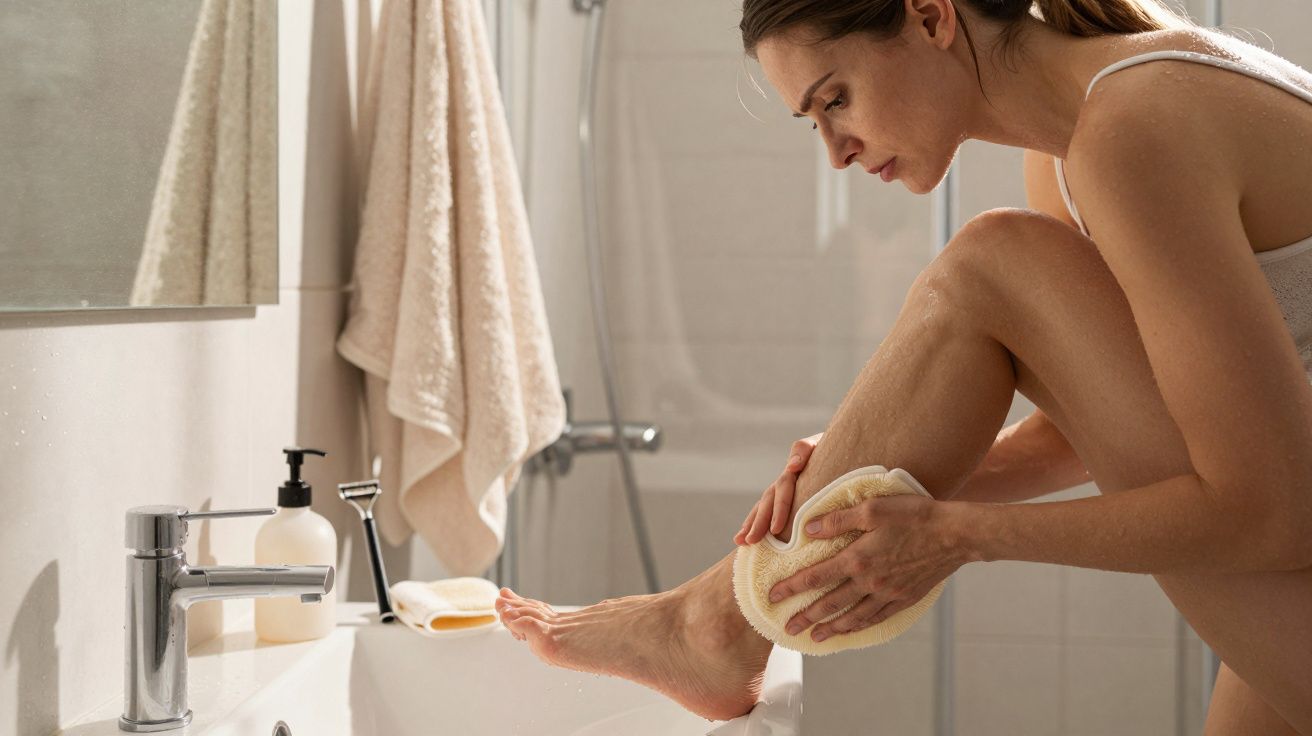
Spray tan preparation is the bit you do in your bathroom before the appointment, when you’re trying to turn “glowy weekend” into “still good on day five”. Exfoliation is the step that decides whether that colour fades evenly or breaks up into elbows, ankles and mystery patches. Get it right and your tan clings on like it belongs there.
Most people blame the solution, the technician, or their shower gel. But longevity is usually decided earlier, when skin is either smooth and ready to hold colour, or uneven and desperate to shed it.
Why longevity is mostly decided before the first spray
A spray tan only stains the top layers of the skin. That’s the deal: it develops fast, looks natural, and fades as your skin naturally sheds. If your surface layer is already flaky, thickened, or uneven, the tan grabs harder in some places and barely takes in others.
The result isn’t just “it didn’t last”. It’s the classic pattern: dark knees, pale shins, speckled chest, hands that look like you’ve been gardening. A good exfoliation doesn’t make the tan darker. It makes it consistent, so it fades slowly and evenly instead of collapsing in pieces.
Smooth skin doesn’t just look better on day one. It fades better on day four.
Skip the usual suspects
Why harsh scrubs and last-minute fixes backfire
That strawberry-scented body scrub with walnut shells feels productive, but it can create micro-abrasions and irritation. Irritated skin drinks product unpredictably, and anything inflamed can develop darker or patchier. The same goes for panicked pre-tan shaving that leaves razor rash, or trying to “polish” dry spots until they sting.
Another quiet mistake: exfoliating the morning of your tan and then slathering on lotion to calm things down. Moisturiser can leave residue that acts like a barrier, especially if it’s rich, oily, or fragranced. You end up with a tan that develops unevenly and fades quicker because it never bonded cleanly.
The exfoliation timing that actually works
The sweet spot is 24 hours before your appointment. That window lets you remove dead skin, shave if you need to, and give your skin time to settle back to normal.
If you’re tanning at home, use the same rule: exfoliate the day before, then apply to clean, dry skin the next day. It feels annoyingly planned, but it’s the difference between “holiday skin” and “why is my ankle polka-dotted?”
What you’ll need
- A gentle exfoliation method (mitt, soft body brush, or mild chemical exfoliant)
- A fragrance-free shower gel
- A clean towel
- Optional: a light, fragrance-free moisturiser for after exfoliating (not right before tanning)
Step-by-step, built for even fading
- Shower in warm water for 3–5 minutes to soften the surface (no need to steam yourself).
- Exfoliate with a mitt or gentle scrub, using light pressure and steady circles.
- Spend extra time on: elbows, knees, ankles, heels, underarms, and the line where underwear sits.
- Rinse thoroughly until skin feels clean, not “conditioned”.
- If you shave, do it now with a fresh razor and minimal product, then rinse again.
- Pat dry. If your skin feels tight, use a light moisturiser that absorbs fully and keep it away from areas that tend to grab colour (knees, ankles, elbows).
- On tanning day: no deodorant, perfume, body oil, or heavy lotions.
Where patchiness starts (and how to stop it)
Dry, thickened areas hold more colour because they’ve got more dead skin to stain. They also shed in chunks, which is why the tan seems to “break”.
Use this quick check in good light after your shower: - If it looks ashy (shins, forearms), it needs gentler, longer exfoliation over a couple of sessions, not one aggressive scrub. - If it feels rough (ankles, heels), treat it like a separate project: exfoliate, moisturise daily, and avoid tanning over cracked skin. - If it’s recently irritated (razor burn, active spots, eczema flare), protect it. A tan over inflammation rarely fades nicely.
Chemical vs physical exfoliation: a calm comparison
Physical exfoliation (mitt/brush) is straightforward and usually easiest to control. Chemical exfoliation (like lactic acid) can be brilliant for rough texture, but timing matters. If you’re new to acids, don’t introduce them the week of a big event and hope for the best.
| Method | Best for | Watch-outs |
|---|---|---|
| Exfoliating mitt | Quick, even prep for most bodies | Over-scrubbing elbows/ankles can irritate |
| Gentle acid (lactic/glycolic) | Bumps, dullness, rough texture | Can sting after shaving; don’t start last minute |
| Dry brushing | Light daily smoothing, circulation feel | Not for very sensitive or inflamed skin |
The tiny habits that keep colour for longer
Exfoliation is the big lever, but the fade is controlled by what you do after. - Keep showers lukewarm and short. Hot water speeds up shedding. - Pat dry, don’t rub yourself like you’re sanding a table. - Moisturise daily with something plain and non-oily. - Avoid long soaks, saunas, and chlorinated pools if you want maximum days. - When it starts to fade, lightly exfoliate once (gently) to avoid that “peeling” look.
If you only change one thing in your routine, make it this: do exfoliation properly, once, the day before, and stop trying to fix things on tanning day.
FAQ:
- Should I exfoliate right before my spray tan appointment? Not ideally. Aim for 24 hours before so skin calms down and you’re not tanning over irritation or residue.
- Do I need to exfoliate if I’m already moisturising daily? Yes. Moisturiser helps the fade, but exfoliation creates the even surface that lets colour develop and wear off uniformly.
- Can I exfoliate after I’ve had a spray tan to make it last? Exfoliating after will shorten its life. Instead, moisturise daily and keep showers gentle; only lightly exfoliate later if the fade becomes uneven.
- What areas should I focus on most? Elbows, knees, ankles, heels, underarms, hands, and any area that feels rough or looks dry in bright light.




Comments (0)
No comments yet. Be the first to comment!
Leave a Comment