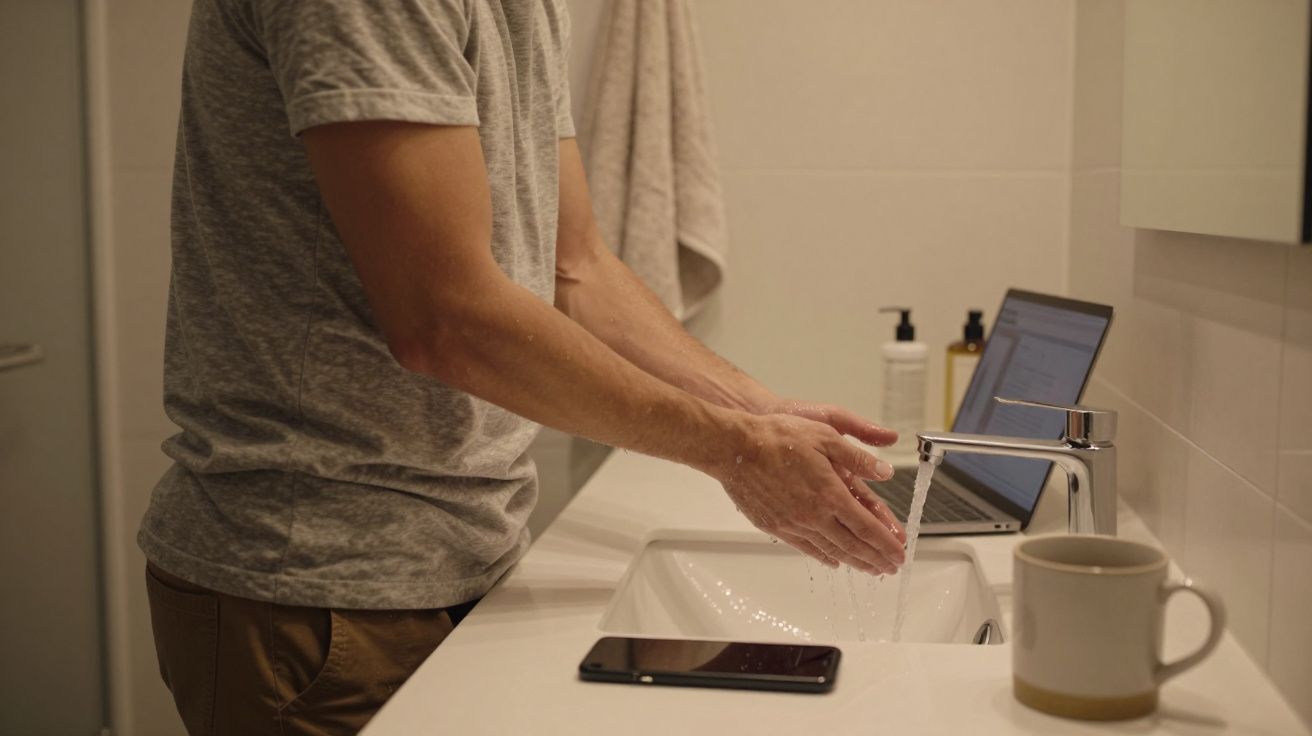
Self-care treatments get sold to us as something you book, buy, or “deserve” after a bad week. But for stress recovery, the ritual people underestimate most is the one you can do in your bathroom, in your kitchen, in your office chair: a deliberately unhurried transition between “on” and “off”. It looks like nothing, which is why it works.
I noticed it the night I couldn’t stop moving. Dinner done, laptop shut, messages answered, yet my shoulders stayed up around my ears like they were waiting for another task to drop. I kept telling myself to relax, then scrolling, then wondering why my body didn’t believe me. The missing piece wasn’t motivation. It was a threshold.
The ritual: a two-minute “closing ceremony” for your nervous system
Most days don’t end; they just fade into the next tab. You finish work and start life with the same jaw, the same pace, the same low-grade alertness. The ritual is simply marking a clear end-small enough that you’ll actually do it, specific enough that your body recognises it as real.
Call it a closing ceremony if you want, but keep it plain. Two minutes. Same steps. No performance. You’re teaching your brain, over and over, that there is a safe boundary where effort stops.
Here’s the version I return to when I’m wired:
- Wash your hands slowly with warm water, like you’re rinsing off the day rather than dirt.
- Dry them fully, noticing the pressure of the towel.
- Put one hand on your chest, one on your stomach, and take five slow breaths.
- Say one line out loud: “I’m finished for today.” (Or: “I can pick this up tomorrow.”)
That’s it. It’s not dramatic, and it won’t fix your life. It just changes the temperature in your body, which is often the first domino in stress recovery.
Why the “small” self-care treatments stick when big ones don’t
Big gestures can backfire because they carry expectation. If you book a spa day and still feel tense, you start treating your stress like a personal failure. Small rituals don’t ask for transformation; they ask for repetition, and repetition is what the nervous system understands.
There’s also a practical truth: when you’re overloaded, you don’t want another decision. A consistent end-of-day cue removes choice. You’re not wondering what would help-you’re doing the thing you always do, like locking the door.
A therapist once framed it to me as “completing the stress cycle”. Your body doesn’t care that you answered the email; it cares whether the alarm state was ever turned down. Self-care treatments that work tend to be boring, sensory, and timed. They give the body proof.
The aim isn’t to feel amazing. The aim is to feel “ended”.
How to build your own version (without making it a whole project)
Pick one action that signals “clean break”, one action that soothes the senses, and one action that points you towards tomorrow. Keep the steps identical for two weeks before you edit anything.
A few combinations that are oddly effective:
- Change into different socks and rinse your face with warm water.
- Make a decaf tea and drink the first three sips standing still.
- Put your phone on charge in another room and dim one light.
- Do a quick shower, then moisturise your hands only-no full routine required.
- Step outside for 60 seconds and look at the sky (yes, even if it’s just London-grey).
Let’s be honest: no one actually does this every day. That’s why it has to be small enough to do on the days you’re least proud of yourself.
When you’re too stressed to “relax”: a template for the rough days
Some evenings your mind won’t co-operate. On those nights, don’t chase calm. Chase completion.
Try a 1–1–1:
- 1 minute to tidy one surface (just one: the table, the sink, the bedside).
- 1 minute of a body cue (hand-wash, shower, stretching calves against the wall).
- 1 minute of tomorrow-proofing (set out a mug, plug in headphones, write one line: “Tomorrow I’ll start with…”).
You’re not fixing everything. You’re telling your system: the day has a boundary, and I am inside it.
What changes when you do it for a week
The shift is subtle at first. You fall asleep a bit easier, or you stop replaying a conversation quite so loudly. You wake up with slightly more choice-less dragged by yesterday’s momentum.
And because it’s consistent, it becomes a kind of low-key self-care treatment you don’t have to schedule. Not a luxury, not a reward. Just a hinge in the day that keeps stress from spilling into the next one.
| Point clé | Détail | Intérêt pour le lecteur |
|---|---|---|
| Mark the end | A two-minute closing ceremony with fixed steps | Helps your body recognise “work is over” |
| Use sensory cues | Warm water, towel pressure, dim light, tea | Grounds stress recovery without overthinking |
| Keep it tiny | A repeatable ritual beats an occasional grand fix | More likely to stick on hard days |
FAQ:
- Is this really a self-care treatment if it’s so basic? Yes. The effectiveness comes from repetition and body cues, not glamour. A reliable “end” signal can be more regulating than a rare big treat.
- What if I work shifts or irregular hours? Attach the ritual to the moment you stop being available-when you clock off, leave the site, or shut the laptop-rather than a specific time.
- I can’t switch off at night. Should I force myself to relax? Don’t force calm. Do completion: a short tidy, a sensory reset (warm water helps), and one small step that makes tomorrow easier.
- How long until it helps stress recovery? Many people notice a shift within a week, but it’s gradual. If stress or sleep problems feel persistent or severe, it’s worth speaking to a healthcare professional for tailored support.




Comments (0)
No comments yet. Be the first to comment!
Leave a Comment