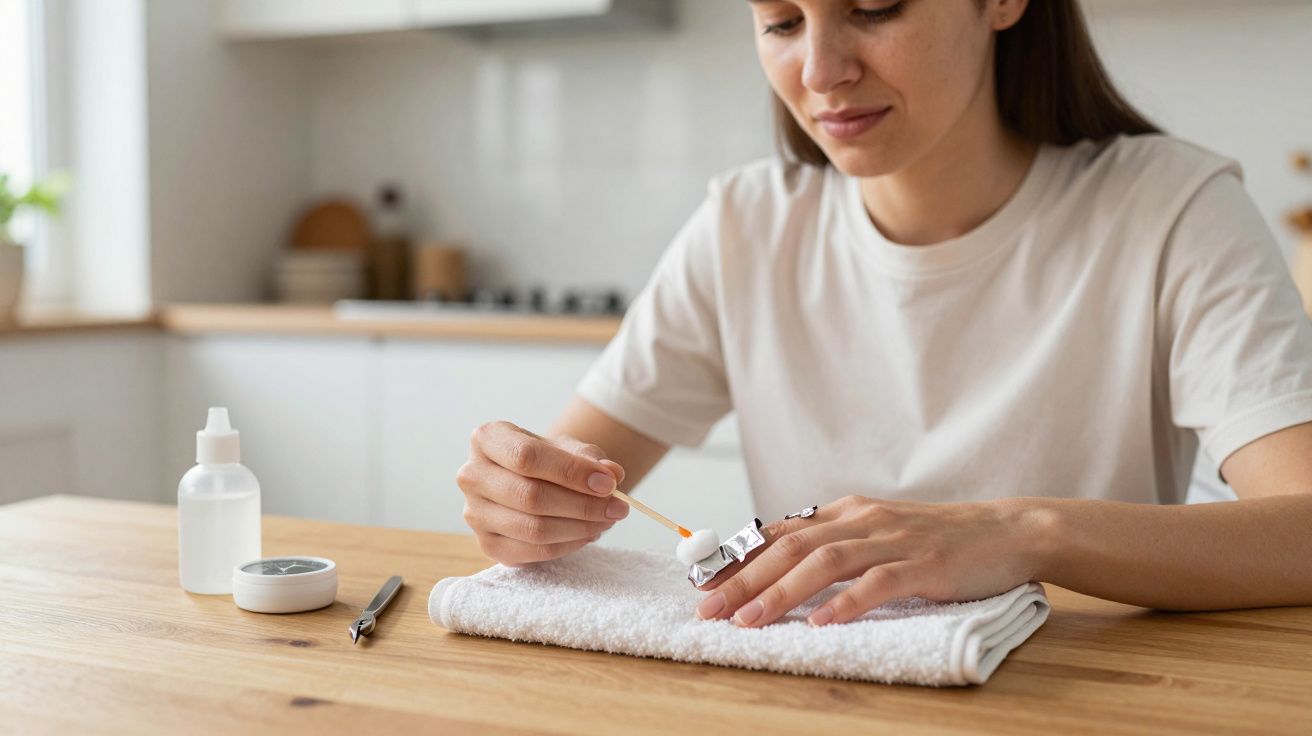
You’re sat at the table with a set that’s ready to come off, and nail removal suddenly feels like a quick little clean-up job. Then plate damage shows up later, quietly-thin spots, soreness, and sets that don’t last like they used to. The mistake isn’t usually the product you used; it’s the way you try to “help” it along when it’s halfway released.
It’s easy to justify in the moment. One nail lifts at a corner, you catch it, and your brain says: that’s basically done. You pull, you scrape, you chase that last stubborn bit-and you don’t notice what you’ve taken with it until the next set starts lifting at week one.
The “half-loose, so I’ll peel it” trap
Most overlays and tips don’t fail all at once. They fail at the edges. A tiny gap opens, water slips in, you feel a rough catch on your hair, and it becomes a sensory problem you want solved now.
The trap is thinking “it’s already lifting, so peeling can’t do more harm.” But when product lifts, it often takes the top layers of your natural nail with it. That’s the plate damage: not a dramatic crack, just gradual thinning where the keratin layers have been forcibly separated.
Picture the common scene. You’ve soaked for a bit, you’ve filed the shine, you’ve wrapped foils, you’re bored. You test a corner with a tool, it gives, and suddenly you’re picking-tiny flicks that feel efficient. Ten minutes later the nails look bare, but they feel hot in the shower, and the surface looks chalky, uneven, almost fuzzy.
What’s actually happening when you “just scrape a little”
Natural nails are layered like compressed pages. Adhesives and cured coatings grip the upper layers; they’re meant to be removed by breaking down the product, not by tearing it away from the nail.
When you pry, you create leverage. That leverage doesn’t only lift the coating-it lifts nail layers. Those microscopic tears become weak points for future sets: product adheres unevenly, prep takes more abrasion to “smooth” things out, and the cycle repeats.
A second issue is timing. Many removals fail because they’re stopped too early: the surface looks softened, but the lower layers of product are still bonded. You feel resistance, so you apply pressure instead of patience. That’s the moment your nail plate pays the price.
“If you have to force it, it isn’t ready,” is the rule most techs live by. The force is what your nail remembers.
A safer removal rhythm that protects future sets
You don’t need fancy tools. You need a sequence that makes it hard to get impatient.
A practical method (for soak-off gels and acrylics)
- Break the seal first: Lightly file the top coat so remover can penetrate. Aim to remove shine, not bulk.
- Soak properly: Use acetone-based remover with cotton and wraps/foils. Set a timer for 10–15 minutes.
- Check one nail, not all ten: Slide product gently with an orangewood stick. If it resists, rewrap and wait.
- Work in layers: Product should flake and slide. Remove what’s ready, then soak again for what isn’t.
- Finish gently: Buff lightly with a fine grit buffer only if needed, then wash hands and apply oil.
The key is that “ready” feels almost boring. It looks like product that has swollen, lifted and lost its grip-so it comes away without digging. If you find yourself scraping to reach “clean,” you’re usually scraping nail plate too.
The one tool habit that makes damage worse
Metal pushers and sharp bits aren’t evil. But they turn impatience into injury because they concentrate pressure into a thin edge. It’s like using a knife to open a parcel: it works, right up until it doesn’t.
If you’re removing at home, choose tools that naturally limit you. Orangewood sticks, plastic pushers, and gentle buffers force a slower pace. They also make it obvious when the product isn’t ready, because they simply won’t “bite” the way metal will.
Common warning signs you’re overdoing it:
- The nail looks white and patchy after removal (top layers stripped).
- You feel stingy sensitivity when washing hands.
- You’re tempted to “even it out” with more filing.
- The next set lifts early despite good prep.
If the nail plate is already thin, what now?
You don’t need a month of suffering. You need a short period of kinder choices so the surface can settle.
Keep it simple for the next couple of weeks:
- Pause aggressive prep: Minimal buffing; focus on cleanliness and dehydration rather than abrasion.
- Use a protective base: A soft builder or rubber base can add support while you grow out damage.
- Oil daily: Not as magic, but as maintenance-flexible nails crack and peel less.
- Shorter length, less leverage: Long nails amplify stress at the free edge and encourage lifting.
If you’re seeing persistent pain, redness, or separation from the nail bed, treat it as a health issue, not a beauty problem-stop services and seek medical advice.
The bigger picture: removal is part of retention
People blame lifting on prep, primer, lamp strength, brand swaps. Sometimes it’s none of those. Sometimes it’s last month’s removal leaving a nail surface that can’t hold onto anything evenly.
A good set starts with a nail that hasn’t been fought. The quiet flex of a healthy plate, the even surface, the lack of sore “hot spots”-that’s what makes adhesion feel effortless.
Removal isn’t the boring end of the appointment. It’s the first step of the next one.
| Habit | What it causes | Better swap |
|---|---|---|
| Peeling “because it’s lifting” | Plate damage and thin patches | Re-soak, remove in layers |
| Scraping with metal tools | Pressure points, soreness | Orangewood/plastic, light touch |
| Filing to “make it smooth” | More thinning, uneven prep | Fine grit only, minimal passes |
FAQ:
- Is it ever okay to peel product off? No. If it’s lifting, it’s already compromised-peeling just turns a small problem into plate damage.
- How do I know it’s ready to remove? It should flake, crumble, or slide with very light pressure. If you need to dig, rewrap and wait.
- What if acetone dries my skin out? Protect the skin with a barrier (like a little oil or balm around the nail), and oil afterwards. Don’t shorten soak time by scraping.
- Can I remove hard gel the same way? Hard gel generally isn’t soak-off; it’s filed down. If you’re not trained, it’s safer to have it removed professionally to avoid thinning the nail plate.
- Why do my future sets lift after “clean” removals? Often because “clean” included scraping or over-filing. Adhesion struggles on a nail plate that’s been thinned and unevenly textured.




Comments (0)
No comments yet. Be the first to comment!
Leave a Comment