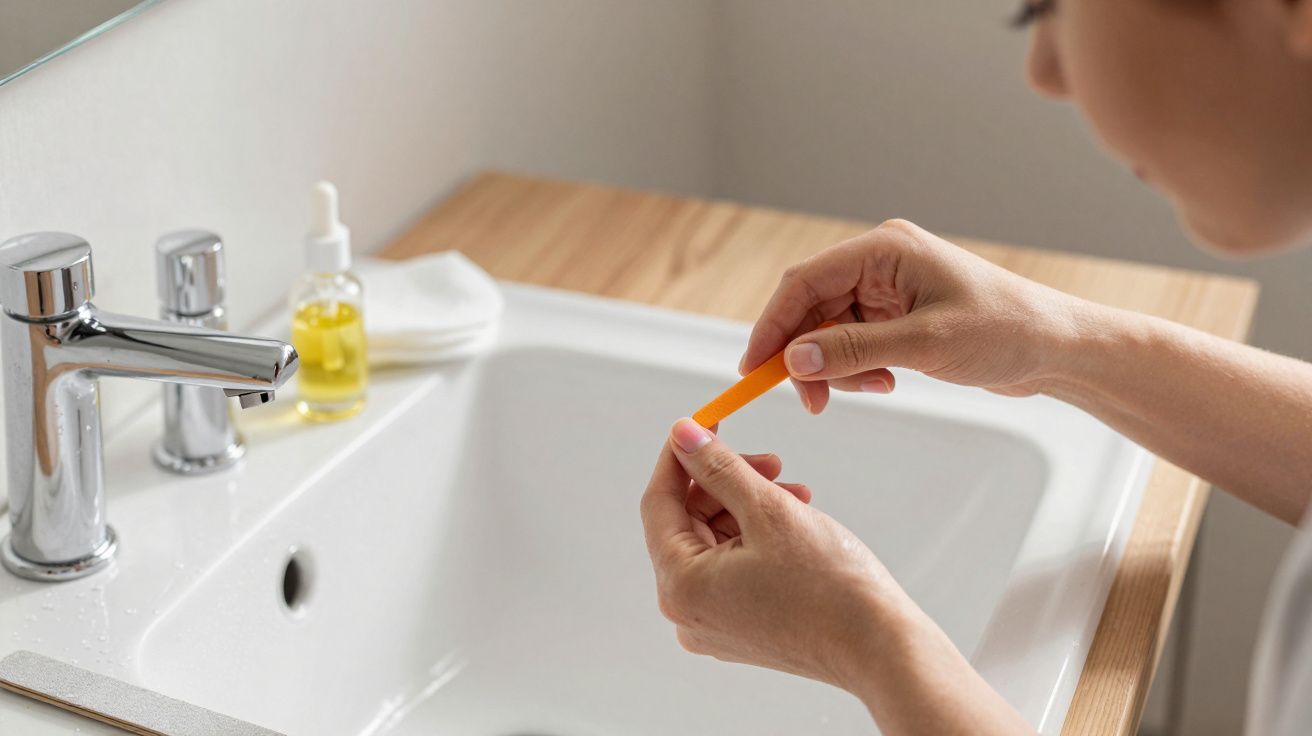
A manicure can look perfect in the chair and still fail in the days after, and technicians can usually trace it back to one thing: cuticle preparation. It matters because it decides whether polish grips clean nail plate or lifts at the edges, and it also decides whether your skin ends up calm or sore. Most people think the “mistake” is picking the wrong colour. It’s not.
You can see it in the first five minutes: hands freshly washed, nails shaped, and then a client instinctively reaches for the little rim of skin at the base and says, “I’ve got loads of cuticle.” The technician smiles, nods, and quietly thinks, That’s not cuticle. That’s living skin and product won’t stick to it the same way.
The mistake technicians clock immediately
It’s overcutting or overpushing, usually at home, usually with good intentions. A quick shove with a metal pusher. A nip with clippers because it looks “tidier”. A soak that turns everything soft so it all feels removable. Then the nail plate is left slightly roughed up around the base, and the skin barrier is left thin enough to sting when anything touches it.
The giveaway isn’t dramatic. It’s a shiny red crescent at the proximal nail fold, little frays at the sidewalls, or that taut look that says the skin’s been stretched past comfort. The client often says they “barely touched it”, which is true in the same way you can “barely” sand a table and still take off the varnish.
What happens next is boring but relentless: inflammation makes the skin swell, the nail area stays damp for longer, and product edges struggle to seal. In a few days you get lifting at the cuticle line, chips that start at the base, or a rough, flaky rim that makes you want to pick again. The cycle renews itself.
Why cuticle preparation is the whole foundation
There’s a difference between removing dead tissue and attacking the seal that protects the nail matrix. Dead cuticle (the thin, translucent film on the nail plate) needs clearing so polish can adhere. Living skin at the base needs respect so it can do its job: keeping bacteria out and moisture in.
When cuticle preparation is done well, the nail plate is clean, dry, and lightly refined, with no ragged edges to catch on hair or clothes. When it’s done aggressively, you get micro-tears, sensitivity, and a surface that’s harder to prep evenly without further trauma. And no top coat can outsmart angry skin.
A technician also knows the second-order problem: clients who over-prep tend to compensate with oil and hand cream right before the appointment. Lovely for comfort, terrible for adhesion unless it’s properly removed. Skin feels better; polish sticks worse.
What “good” looks like in the chair (and at home)
Good prep is quieter than people expect. It’s not about making the base look empty or “pulled back”. It’s about clearing the nail plate without stripping the border of skin that keeps everything stable.
A simple, repeatable version:
- Skip soaking unless you’ve been told to for a specific service. Water plumps the nail plate and can make polishing less predictable.
- Use a remover or softener sparingly, then wipe away what lifts easily. If you have to force it, it’s not ready (or it’s not dead).
- Gently push back with a soft tool and light pressure, focusing on the nail plate film, not the skin ridge.
- Clean and dehydrate the nail plate before polish: remove oils, then let it fully air-dry.
- Leave hangnails alone unless you can trim only the dead bit cleanly. Tearing one is basically an invitation to more.
Let’s be honest: the temptation is the “one more pass” moment. One more scrape because the light catches something. One more nip because it looks uneven. That’s where most damage happens, right when you’re trying to make it perfect.
“If I can see you’ve chased the cuticle, I already know you’ve been fighting lifting,” says Marla, a salon technician who does back-to-back gel sets. “The nail doesn’t need to be bare. It needs to be clean.”
The quick self-check technicians wish you’d do
Before your next manicure, look for these small signs:
- A pink, tender halo at the base of the nail
- Stinging when sanitiser or remover touches the area
- Flaky skin that appears two days after you “tidied up”
- Lifting that starts at the cuticle line rather than the free edge
If you tick two or more, pause the home tools for a week. Oil the skin, leave it alone, and let the barrier rebuild. Your next service will be easier, and your nails will look better for longer without you doing more work.
What to ask for if you want it done gently
You don’t need specialist language. You just need to describe the outcome you want.
- “Can we keep the cuticle work minimal? I’m prone to soreness.”
- “Please focus on removing the cuticle on the nail plate, not cutting the skin.”
- “If anything looks like living skin, I’d rather leave it than clip it.”
A good tech won’t be offended. They’ll be relieved. It gives them permission to prioritise longevity and comfort over that ultra-stripped look that photographs well and wears badly.
| What the technician sees | What it usually leads to | Better approach |
|---|---|---|
| Red, shiny cuticle line | Tenderness + lifting | Light push, no chasing |
| Ragged sidewalls/hangnails | Picking + splits | Trim dead bits only |
| Oily base right before service | Peeling at the edges | Arrive clean; oil after |
FAQ:
- Is it ever okay to cut the cuticle? Sometimes a technician will carefully trim dead, lifted tissue. Cutting living skin routinely increases soreness and can make lifting more likely.
- Why does my polish lift at the cuticle first? It often means the nail plate wasn’t fully cleared/dried at the base, or the area was irritated and swollen so product couldn’t seal cleanly.
- Should I oil my cuticles before my appointment? Oil is great for daily care, but avoid applying it right before your service unless you can thoroughly cleanse the nail plate afterwards.
- Do I need to soak my nails to prep them? Usually no. Soaking can make the nail plate absorb water, which can interfere with adhesion for some services.
- What’s the safest at-home tool? A soft, gentle pusher and a buffer used lightly can be enough. If your tool makes you want to “scrape”, it’s probably too aggressive for regular use.





Comments (0)
No comments yet. Be the first to comment!
Leave a Comment