You leave the salon feeling invincible, then your phone buzzes: “Can I get them wet yet?” Lash aftercare is the boring bit that keeps that fresh set looking full, because it protects the adhesive bond while it finishes curing and settles into daily life. Ignore it and you don’t just “lose a few early” - you shorten retention, twist the direction of the fans, and end up booking infills like emergency appointments.
I watched a client do the classic move at the desk: glossy lashes, perfect map, then she pulled her hood up and rubbed her eyes like she’d forgotten she had a face. She wasn’t trying to ruin them. She just didn’t realise there’s one rule that matters more than any cleanser brand or lash shampoo ritual.
The rule almost everyone breaks (and pays for)
Don’t touch them. Not to “check they’re even”. Not to peel off a bit of mascara you swear you didn’t wear. Not to pick at one lash that feels “pokey”.
It sounds too basic to be the main thing. Yet it’s the fastest way to mess with the set, because fingers do three damaging jobs at once: they add oils, they add pressure, and they create tiny twisting forces that stress the adhesive bond at the base.
Think about how you touch your face on autopilot - leaning on your hand at your desk, wiping tears, pushing hair back, rubbing the inner corners when you’re tired. Most clients don’t remember doing it. They only notice the fallout: gaps that appear on one side, fans that start leaning, and “shed” that looks suspiciously like whole extensions sliding off.
Why it matters: the bond is strong… but not magical
Lash adhesive is designed to hold through showers, workouts and normal cleansing. But it’s also a rigid material sitting on a flexible surface: your natural lash bends, grows and sheds; the extension acts like a tiny lever.
When you rub or pinch, you’re not simply “moving the lash”. You’re putting sideways pressure right where the extension meets the natural lash. That’s where the adhesive bond lives, and repeated micro-stress there can cause:
- early release (extensions popping off with a natural lash that wasn’t ready to shed)
- twisting (the extension rotates and sits at an angle, catching more and feeling “spiky”)
- clumping (adjacent lashes stick together after a bit of moisture and friction)
- irritation (because now you’re aware of them, you touch more, and the cycle repeats)
The frustrating bit is that the set can look fine for 24 hours, then unravel quickly. Not because the adhesive was “bad”, but because the lashes were treated like false strips you can adjust with your fingertips.
The everyday moments that break the rule
Most aftercare goes wrong in ordinary places, not in dramatic “I jumped in a pool” scenarios. If you want better retention without buying anything new, look at these habits first:
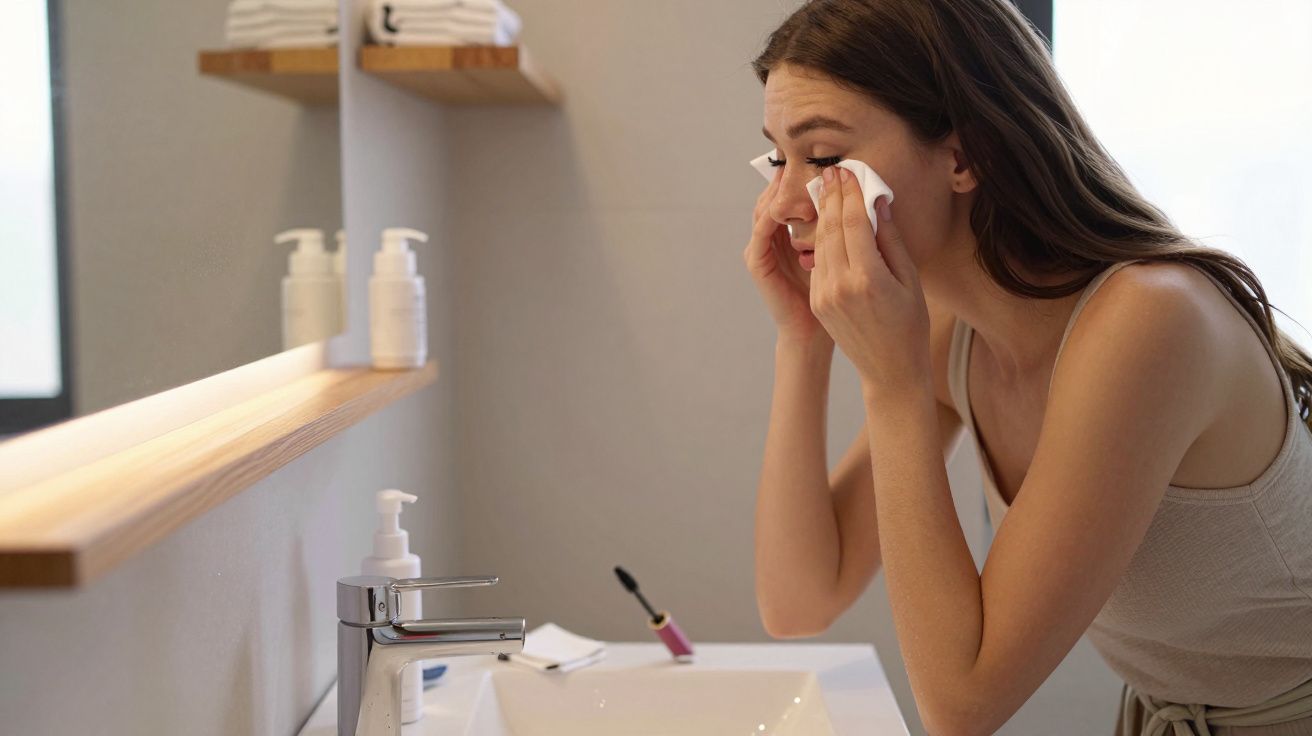
- Make-up removal: dragging a cotton pad across the lash line, especially with balm that isn’t properly emulsified.
- Crying or watery eyes: wiping side-to-side rather than blotting.
- Contact lenses: tugging the lid to insert or remove lenses, then rubbing reflexively.
- Hair and hoodies: pulling jumpers over your head so the cuff catches the lash tips.
- Sleeping: face-down or on a rough pillowcase, where the lash tips get pushed and bent for hours.
None of this requires you to be “high maintenance”. It just requires you to treat them like a delicate surface for the first week, then like a habit for the rest of the set.
The fix: what to do instead (so you’re not doomed by reflex)
Replace “touching” with two lower-damage moves: blot and brush.
If they feel wet, steamy, or a bit tangled after sleep, do this:
- Blot around the eyes with a clean tissue or lint-free pad. Press and lift; don’t wipe.
- Let them air-dry for a minute if you can, or use a cool setting on a hairdryer at arm’s length.
- Brush with a clean spoolie from mid-lengths to tips, lightly. If you’re forcing it, you’re doing it too hard.
And if something feels “stuck” or sharp, don’t go hunting with your nails. Wash, dry, brush. If it still pokes, message your lash tech - it’s often one crossed extension that can be fixed in two minutes, before it starts a week-long pick-at-it saga.
“The goal isn’t to baby them. It’s to stop your hands becoming the thing that breaks them.”
The 60-second aftercare routine that actually holds up in real life
People love complicated rules. They also don’t follow them. Here’s the routine most clients can stick to:
- Clean once a day with a proper lash cleanser (or a tech-approved gentle foam) and a soft brush, especially if you wear eye make-up or have oily lids.
- Rinse thoroughly, because residue is what makes lashes feel itchy and “need touching”.
- Dry properly (blot + air or cool dry), then brush once.
That’s it. Not a ten-step spa treatment. Just clean lashes so they don’t itch, and no rubbing so the adhesive bond isn’t being torqued every time you’re bored in a meeting.
| Moment | Do this instead | Why it helps |
|---|---|---|
| Itchy corner / watery eye | Blot, don’t rub | Stops sideways stress at the base |
| After cleansing/shower | Dry properly before brushing | Prevents clumping and twisting |
| A lash feels “off” | Wash + brush; then ask your tech | Fixes the cause without picking |
FAQ:
- Can I get my lashes wet straight away? Usually yes with modern adhesives, but follow your technician’s specific guidance. Wet is fine; rubbing and steam-heavy saunas with face contact are where most damage happens.
- What if I accidentally rub my eye once? Don’t panic. Cleanse, dry, brush gently, then leave them alone. One slip is rarely fatal; repeated rubbing is.
- Is oil the main enemy? Oil can soften and contaminate the lash line, but pressure and friction are what physically stress the adhesive bond. Most “oil problems” show up because people rub more when lashes feel dirty or itchy.
- Why do my lashes twist on one side? It’s often sleeping position, habitual face-touching, or pulling jumpers over your head. Directional stress over time rotates the extensions.
- Should I use a lash serum with extensions? Some are compatible, some aren’t. Check with your technician; the wrong formula can increase shedding or cause irritation that leads to more touching.




Comments (0)
No comments yet. Be the first to comment!
Leave a Comment