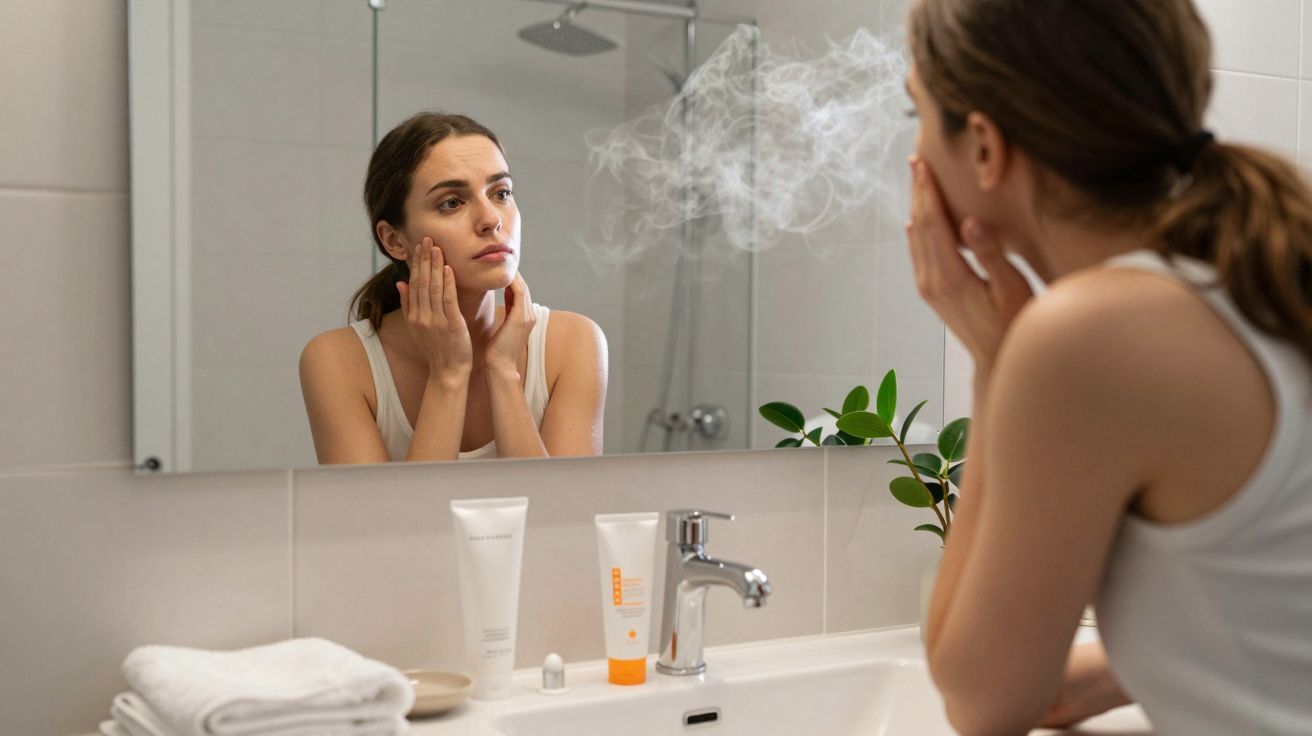
People talk about skin glow as if it’s a lighting trick-something that appears when you’ve “been good” and vanishes the second you’re not. But what most people are actually noticing is overall balance showing up on your face: hydration, sleep, stress load, digestion, movement, and how hard your skin has been working to keep up. That matters because a glow isn’t just cosmetic feedback; it’s often the earliest, quietest signal that your routine is either supporting you-or borrowing energy from you.
I first clock it in the same place every time: a mirror that doesn’t flatter, under bathroom downlights that make everyone look slightly tired. A friend will come round, apologise for being “a state”, then I’ll catch it-cheeks with a soft sheen, eyes that look clearer, skin that seems to sit smoother on the bones. The sort of glow you can’t point to with a finger, but you feel it in the room.
And because we’re human, we reach for explanations we can buy. New serum. Better primer. A facial. Maybe. Yet the more interesting truth is that glow has a boring backbone: consistency, not intensity. The body does “bright” when it’s not firefighting.
The moment people notice it (and why it feels like a mystery)
Glow gets spotted in ordinary interactions: on the Tube when someone looks up from their phone, in a meeting when you’re not hiding behind your fringe, in a photo taken by someone else. It’s rarely the first day of a new product. It’s more often week three of doing a few small things without drama.
That’s why it’s hard to explain. Your skin is the visible edge of invisible systems-circulation, hormones, inflammation, hydration, barrier function-so the cause rarely matches the story we want to tell. We want one hero product; the body wants a steady environment.
You can chase shine and end up looking oily and irritated. Skin glow is different: it reads as rested, calm, evenly coloured, a kind of “light from within” that’s mostly about how evenly the surface is behaving.
- “You look well” (often means sleep and stress are improving)
- “Have you been away?” (often means light exposure, movement, less screen time)
- “What are you using?” (sometimes true, often just the easiest question)
What “glow” actually is, in skin terms
Here’s the unromantic version. A glow tends to show up when light can bounce cleanly off the outer layer of skin instead of getting scattered by flakes, congestion, redness, or dehydration lines. That needs two things: a reasonably smooth surface, and a barrier that isn’t inflamed or stripped.
A healthy barrier keeps water in and irritants out. When it’s disrupted, you might still look shiny-because the skin is overcompensating with oil-but it won’t look even. Glow has a softness to it; it doesn’t look like a wet forehead at 3pm.
If you’re trying to decode your own face, look for patterns rather than single days. Does your skin look brighter after two nights of decent sleep, not one? Does it dull when you skip meals, even if you’re using the same moisturiser? That’s overall balance talking.
The quiet drivers: where overall balance shows up on your face
A glow is often a side effect of a life that’s slightly less jagged. Not perfect. Just steadier.
Sleep is the obvious one, but it’s not only about hours; it’s about regularity. Stress is another: cortisol doesn’t announce itself as “stress”, it shows up as breakouts that linger, redness that doesn’t settle, or that tight feeling that makes you over-exfoliate. Hydration matters too, but not as a punishment-more as a baseline so your skin isn’t constantly rationing.
Then there’s food, which people love to moralise. The simplest useful frame is this: are you getting enough protein and fibre most days, and are you eating in a way that keeps your energy stable? Big blood sugar swings can read on the skin as puffiness, dullness, or inflammation. The goal isn’t “clean”; it’s predictable.
Finally: movement. Not “burn”. Just circulation and lymph flow doing their quiet jobs. A brisk walk can make your face look more alive in a way no highlighter truly replicates.
A practical way to “earn” glow without making it a project
If you want skin glow that people notice but can’t explain, treat it like compound interest. Small deposits, boring frequency.
Start by removing the friction. One cleanser you’ll actually use. One moisturiser that doesn’t sting. SPF you don’t hate. Then add actives slowly, like you’re negotiating with your skin rather than conquering it.
A simple, steady routine:
- AM: gentle cleanse (or rinse), moisturiser, SPF 30+
- PM: cleanse, moisturiser; add a targeted active 2–3 nights a week (not nightly by default)
- Weekly: one “support” habit (sleep-in, long walk, meal prep, earlier bedtime) that improves overall balance more than any mask
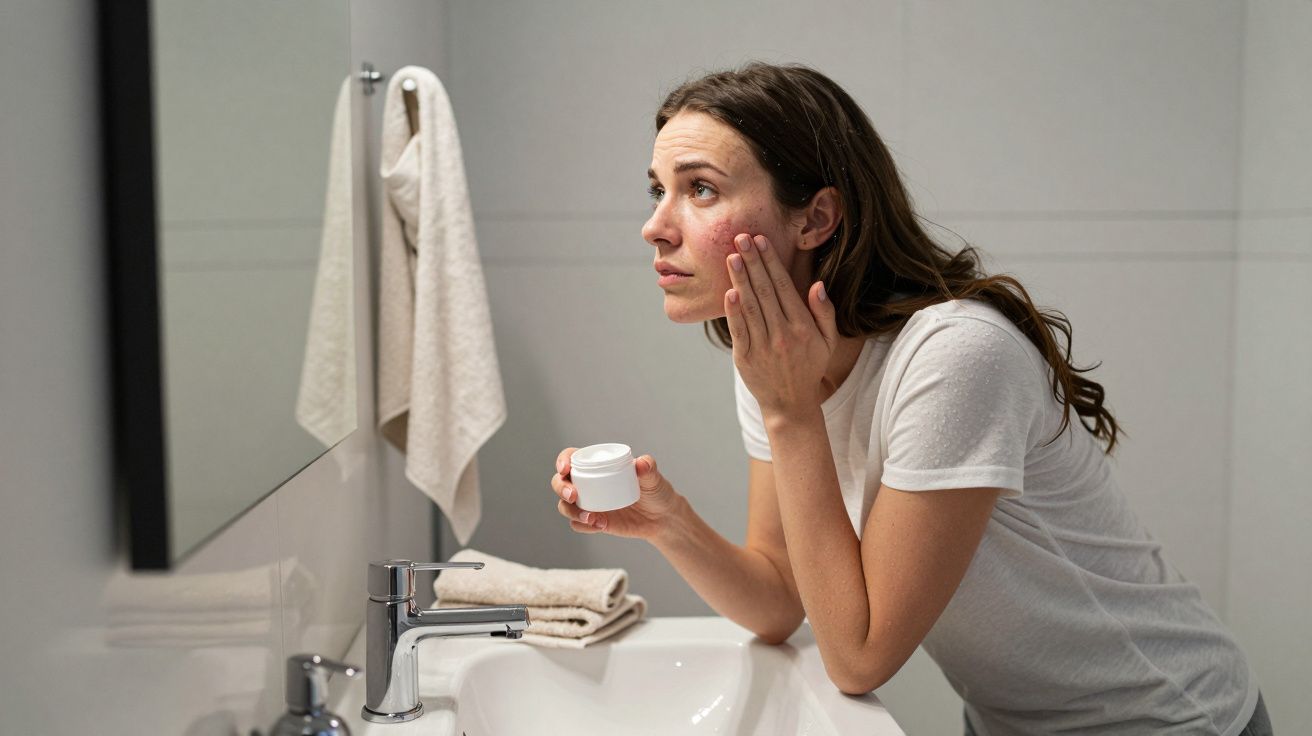
If you’re using exfoliants, remember: more is not brighter. Overdoing acids or scrubs often gives a short-lived shine followed by sensitivity, redness, and that dull, tight rebound. The glow people admire usually comes from calm skin, not freshly sanded skin.
A quick “glow audit” you can run in five minutes
Try this the next time you catch yourself thinking, Why do I look tired even though I’m doing everything? Look for the simplest mismatch.
- Barrier check: does moisturiser sting, or is your skin tight after cleansing?
- Inflammation check: are you redder than usual, or breaking out in the same spots?
- Dehydration check: do fine lines look sharper by afternoon?
- Rhythm check: have sleep and meals been irregular, even if “healthy”?
- Load check: is your routine adding products faster than your skin can adapt?
Often, the fix isn’t adding. It’s pausing, simplifying, and letting your skin catch up with your life.
| What people see | What it often reflects | What to try next |
|---|---|---|
| “Bright” cheeks, even tone | Calm barrier + hydration | Gentle routine, consistent moisturising, SPF |
| Dullness, rough texture | Dehydration, slow turnover, stress | Sleep regularity, mild exfoliation 1–2x/week |
| Shine without glow | Stripped skin or congestion | Reduce actives, check cleanser, add barrier support |
When it’s not just “one of those weeks”
Sometimes a lack of glow is just winter, stress, or a busy spell. But if you notice persistent changes-sudden acne, facial flushing, ongoing dryness, hair shedding, extreme fatigue-it can be worth speaking to a pharmacist or GP. Skin is honest, but it’s not a diagnostic tool on its own.
Still, most of the time the answer is less dramatic than we fear. Glow returns when your inputs get steadier than your outputs. The body loves a routine it can trust.
FAQ:
- Is skin glow the same as oily skin? No. Glow tends to look even and calm; oiliness often looks shiny in specific zones and can come with congestion or irritation.
- What’s the fastest way to look more glowy tomorrow? Sleep, hydration, a gentle cleanse, moisturiser, and SPF. For makeup, a small amount of illuminator on high points beats heavy layers.
- Do I need lots of actives (retinol, acids, vitamin C) for glow? Not necessarily. Actives can help, but they work best on a stable barrier. Too many too soon often dulls skin through irritation.
- Why do I look glowy on holiday? More daylight, more walking, less stress, better sleep, and simpler routines-overall balance improves, and your skin shows it.
- When should I seek professional advice? If you have persistent redness, painful acne, eczema flares, or sudden changes that don’t settle with a simpler routine, check in with a pharmacist, GP, or dermatologist.


Comments (0)
No comments yet. Be the first to comment!
Leave a Comment