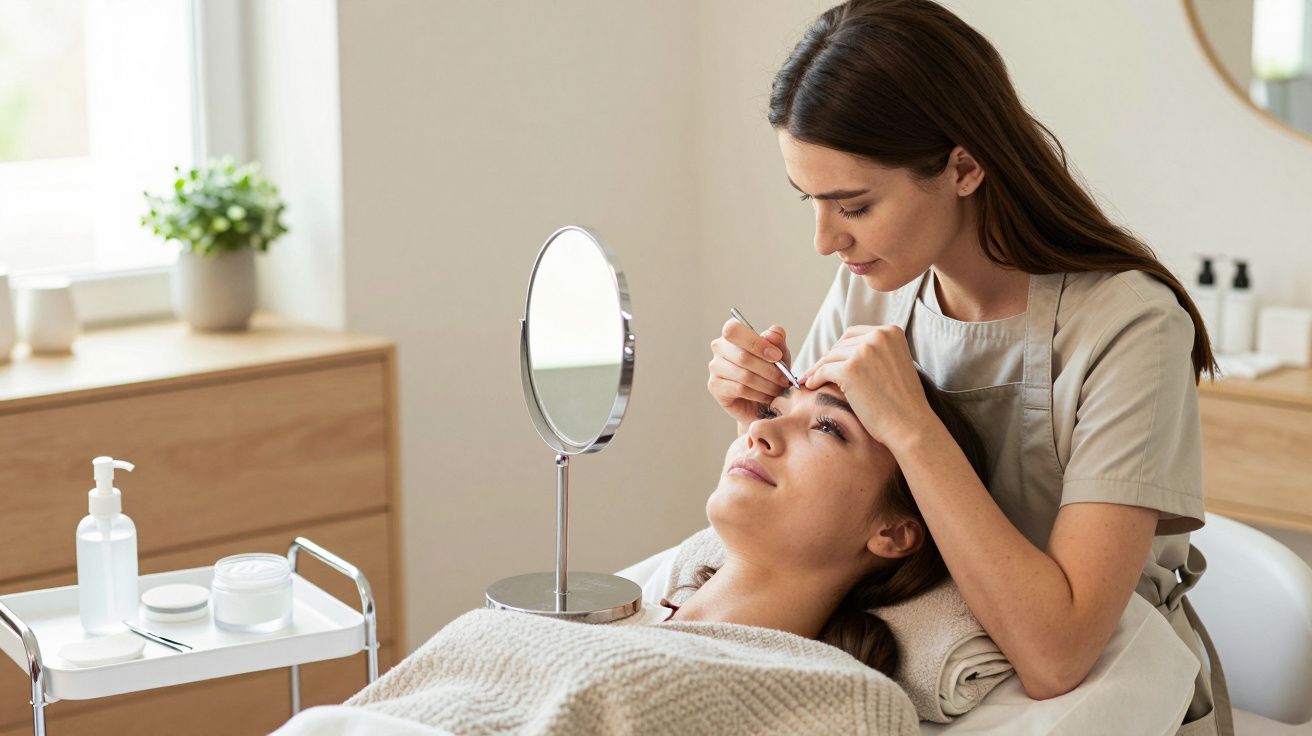
Beauty appointments often turn into quiet negotiations between beauty myths and client beliefs. A lash fill, a gel set or a facial is also a moment where people ask, “Is this true?” and decide what to do with their skin, hair and money. Lately, many technicians have stopped correcting one particular kind of myth-not because it’s right, but because the correction rarely lands the way clients hope.
The shift is subtle. Instead of debunking every claim, more pros are focusing on what’s safe, what’s realistic, and what actually changes the result you’ll see in the mirror.
The myth they let slide: “If it tingles, it’s working”
In salons and treatment rooms, the most persistent idea is that discomfort equals effectiveness. Clients describe a “spicy” cleanser, a stinging peel, a tight mask, and assume the sensation proves it’s doing more.
Technicians used to challenge this head-on. Now many simply translate it: tingling can mean active ingredients, but it can also mean irritation, barrier damage, or a formula that’s wrong for your skin that day. Arguing tends to turn into a test of pain tolerance, and nobody wins.
A sensation is information, not a success metric.
Why this belief sticks
It’s reinforced by marketing language (“intense”, “clinical”, “professional strength”), by social media before-and-after stories, and by the logic people apply to workouts: if it burns, it must be improving.
The problem is that skin doesn’t build “fitness” the same way. Overdoing actives can create redness, flaking, breakouts and long recovery windows that make every other product feel worse.
What technicians watch instead
Rather than asking “Did it sting?”, many will ask questions that predict outcomes more reliably:
- Does your skin feel calm the next morning or reactive?
- Are you peeling in sheets or just getting a light, even dryness?
- Did makeup sit better, or did it cling to patches?
- Has sensitivity increased around the nose, eyes or jawline?
Those answers tell a technician whether to scale up, step back, or change course entirely.
The business reason: correcting myths can sound like criticising the client
Most people aren’t attached to the science of a myth-they’re attached to the routine it justifies. When a technician bluntly corrects a belief, clients often hear: you’ve been doing it wrong.
That’s especially true when the myth is tied to effort (“I scrub daily”), money (“This serum cost a fortune”), or identity (“I’m low-maintenance, so I use one strong product”). The correction can feel personal, even when it’s meant kindly.
So pros increasingly choose a softer tactic: they keep the appointment moving, protect the relationship, and steer towards safer habits without staging a debate.
How the “tingle myth” shows up across treatments
It isn’t just skincare. The same logic appears in nails, brows and lashes, where sensation is often treated as proof of power.
- Brow tint: clients expect burning because “that’s how you know it’s taking”.
- Lash extensions: watery eyes and itching get normalised as “your eyes adjusting”.
- Nails: heat spikes in the lamp are treated as a rite of passage rather than a sign to modify the cure or product choice.
A technician may still flag red lines-pain, swelling, persistent itching, blistering-but they may stop trying to re-educate every mild tingle into a lecture about irritation pathways. They’ll just change the plan.
A more useful frame: comfort, consistency, and control
What replaces myth-busting is a simple framework that keeps clients safe and results stable.
Comfort: the immediate check
A treatment can feel active without feeling alarming. Mild warmth or short-lived tingling can happen, but it should be brief and predictable-not escalating, not sharp, not followed by lasting redness.
If you feel compelled to “push through”, that’s usually the point to say so. Good technicians would rather adjust than guess.
Consistency: the long-game that actually changes skin
Barrier-friendly routines are boring, and that’s the point. Skin that isn’t constantly irritated tolerates actives better, heals faster, and shows clearer results over weeks.
Many pros will prioritise:
- daily SPF you’ll actually wear
- a cleanser that doesn’t leave you tight
- one active ingredient introduced slowly
- moisturiser that calms, not just “seals”
Control: being able to repeat the result
A product that gives a dramatic overnight peel but leaves you unpredictable for a month is hard to work with. Technicians want repeatability: the ability to plan your next facial, tint, or set without playing catch-up with inflammation.
Quick guide: what to tell your technician (so they can help)
People often under-report reactions because they assume discomfort is normal. The details matter more than you think, especially if you’re layering home products with in-salon treatments.
- When did the sensation start: immediately, or after a few minutes?
- How long did it last: seconds, hours, days?
- What did it look like: redness, hives, swelling, patchy peeling?
- What else changed that week: retinoids, acids, new SPF, antibiotics, holiday sun?
That information lets a technician modify strength, timing, patch testing, and aftercare without turning the appointment into a confrontation about myths.
What this means for your next appointment
If a technician doesn’t correct your “tingle equals results” comment, it doesn’t mean they agree. It usually means they’re choosing the fastest route to a safer outcome: adjust the service, simplify your aftercare, and keep you coming back with skin that’s improving rather than recovering.
A practical rule to keep: intensity is optional; irritation is not. If you want stronger results, ask for a plan that scales gradually, with clear signs for when to stop.
FAQ:
- Is tingling always a bad sign? No. Some actives can tingle briefly, especially on freshly cleansed skin, but it should be mild and short-lived. Strong, worsening or lingering stinging is a reason to stop and reassess.
- Why don’t technicians just tell clients the myth is wrong? Because direct correction can sound like blame, and it can derail the appointment. Many pros get better outcomes by shifting the routine gently and focusing on what’s safe and repeatable.
- What should I do if my eyes water during lash or brow services? Tell your technician immediately. Watery eyes can be normal with fumes, but persistent burning, itching or swelling can signal sensitivity and needs a change in product, placement or ventilation.



Comments (0)
No comments yet. Be the first to comment!
Leave a Comment