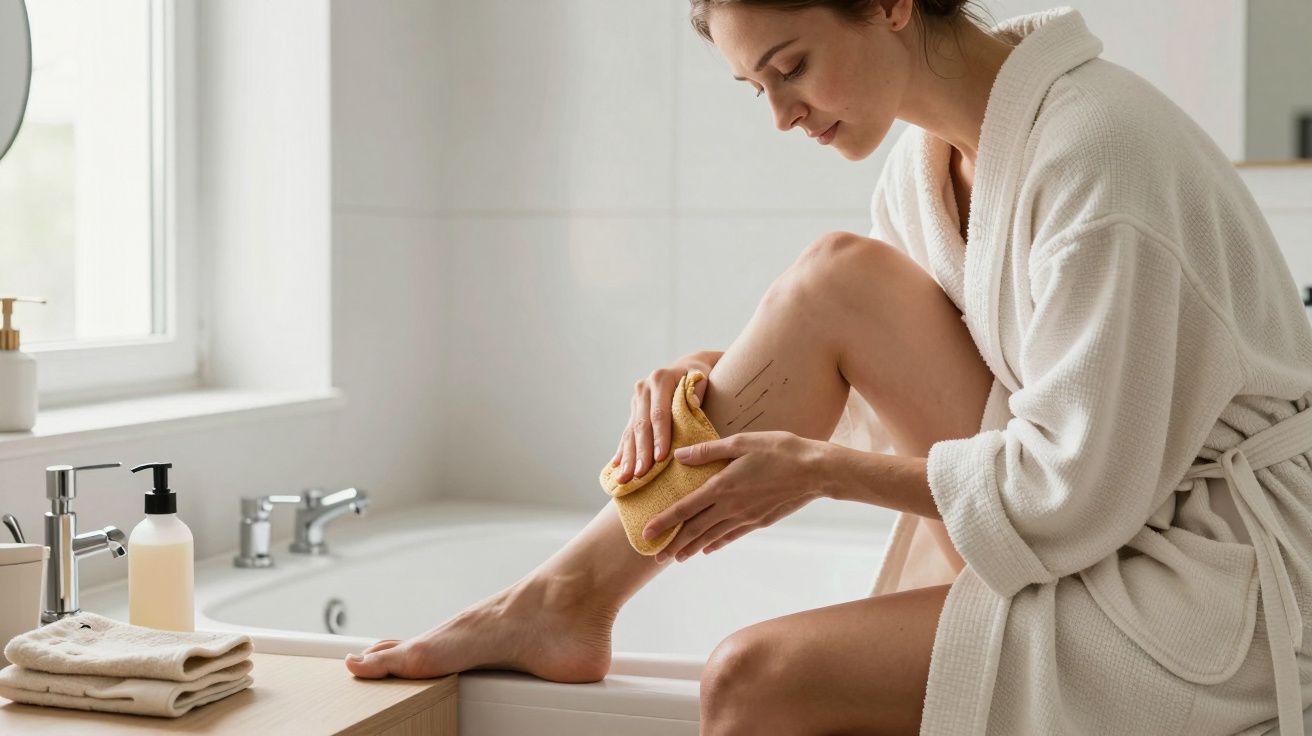
You get home, catch yourself in the hall mirror, and the spray tan looks flawless. Then daylight hits you the next morning and the patchiness appears: faint stripes down a shin, a darker crescent at the wrist, a pale gap under the bum. If you’ve ever used a spray tan for an event, holiday, or just to feel a bit more “awake” in winter, that whiplash is exactly why the basics matter.
It’s not vanity, really. It’s maths: colour plus light plus skin texture. Most “bad tans” aren’t actually too dark - they’re uneven.
Why a tan can look perfect indoors and awful outside
Bathroom lighting is kind. It’s warm, it’s close, and it blurs the transition between slightly darker and slightly lighter areas. Daylight is ruthless: cool, flat, and honest about every edge you accidentally created.
Patchiness usually shows up where your skin behaves differently. Knees and ankles grab colour because they’re drier and more textured. Shins go streaky because you miss a strip while rushing. Hands look dirty because you’ve used them as tools, not an area to be tanned.
It can also be timing. The tan develops gradually, and what looks “even” at hour one can oxidise into obvious bands by hour eight, especially if you’ve sweated, slept with a crease, or worn tight leggings.
“If it’s streaky in the morning, it probably wasn’t the colour. It was the map you painted underneath.”
The quiet culprits: where streaks and patchiness actually come from
Most people blame the product first. Often it’s the prep - or the lack of it - but not in the high-maintenance way brands imply. It’s usually one of these boring, repeatable problems.
1) Dry patches acting like velcro
Any area that’s drier than the surrounding skin will go darker. That includes:
- ankles, toes, heels
- knees and elbows
- knuckles and the sides of hands
- the outer edges of feet where straps rub
If you moisturise everything heavily, you can cause a different issue: the tan won’t take in some places and will cling in others, creating pale islands next to dark borders.
2) Too much product in “bend” zones
Wrists, behind knees, inner elbows - places that fold - collect excess solution. When you move, it pools. When it dries, it sets like a tide mark.
Sleeping makes this worse. One bent arm can give you a crisp line that only appears when the tan deepens.
3) Rushing the blend when the guide colour looks even
That initial bronzer (the guide colour) is a confidence trick. It shows you coverage, not the final result. You can have full coverage and still have uneven development if the spray was heavier in one pass than another, or if you didn’t buff the edges.
4) Water, sweat, and friction during development
A quick “it’ll be fine” shower rinse. A jog. Tight jeans. A bra band. Carrying a bag on the same shoulder. Even doing the washing up without gloves.
All of it can interrupt developing DHA in odd little patches. You don’t notice it at the time. You notice it in daylight.
How to get an even spray tan without becoming a full-time exfoliator
The goal isn’t perfect skin. It’s consistent skin. You’re trying to make your body a smooth canvas so the colour develops at roughly the same speed everywhere.
The 10-minute prep that actually changes the outcome
Do this the day before if you can:
- Shave or remove hair first, then wait. Freshly shaved skin can grab colour in pores, especially on legs.
- Exfoliate lightly, focusing on elbows, knees, ankles, and feet. Not “scrub until sore” - just enough to lift dead skin.
- Moisturise strategically, not generously. A thin layer on the driest zones is often better than slathering everywhere.
On the day, keep your skin clean and boring: no deodorant, perfume, body oils, or heavy lotions if you can avoid them. Those can create invisible barriers that develop into pale patches.
Application habits that prevent streaks
Whether it’s a professional booth, a handheld machine, or mousse at home, the principle is the same: thin layers, consistent movement, and softer edges.
- Use less than you think on hands, feet, knees, and elbows.
- Blend those areas last, with whatever is left on the mitt.
- Keep your arm moving in the same direction; stop-start spraying creates stripes.
- If you’re using a booth, take the position prompts seriously. Half-turns and awkward elbows are where patchiness is born.
When it’s already streaky: the calm fix (not the panic scrub)
There’s a special misery in trying to “even it out” and making it worse. The trick is to think in two lanes: reduce the dark bits and soften the pale bits.
To fade darker stripes and patches
- Take a warm shower and use a gentle exfoliating glove on the darkest areas only.
- Apply body lotion afterwards and let the skin settle for a few hours. Dryness makes those patches look even darker.
- For really stubborn areas (ankles, wrists), a mild chemical exfoliant can help, but go slowly. Overdoing it can create raw, pale new patchiness.
To disguise lighter areas
- Don’t re-tan the whole body immediately. You’ll deepen the dark patches too.
- Use a small amount of gradual tanner or tinted body lotion on the pale strip, and feather it outward.
- If it’s just for one day, body makeup can be the least stressful option. It’s not “cheating”; it’s choosing peace.
A quick “why did this happen to me?” checklist
If you’re trying to work out the cause, it’s usually one of these:
| What you notice in daylight | Likely cause | Quick fix next time |
|---|---|---|
| Dark knees/ankles, pale calves | Dry skin grabbing colour | Moisturise those zones lightly before tanning |
| Streaks down shins | Missed blending / uneven passes | Apply in thinner layers; buff with mitt |
| Dark wrists/hands | Product build-up + hand washing | Use leftovers only; wipe nails and palms |
| Pale patches under straps/waistbands | Friction during development | Loose clothing; avoid tight bands for 6–8 hrs |
The bigger truth: spray tan is less about “skill” and more about repetition
People who always look evenly bronzed aren’t necessarily better at tanning. They just have a routine they repeat: the same prep, the same order, the same “don’t wear skinny jeans after” rule.
And yes, some bodies are harder to tan evenly than others. If you’ve got very dry skin, keratosis pilaris on arms, or rough patches from shaving, patchiness is more likely - not because you’ve done something wrong, but because the canvas isn’t uniform yet.
FAQ:
- How long should I wait to shower after a spray tan? Follow your product’s guidance, but many need 6–8 hours to develop fully. Showering too early can create pale patches or streaks where water runs.
- Why are my hands always darker than the rest? Hands tend to get extra product from applying and blending, and the skin around knuckles is often drier. Use less product there and blend with leftovers on the mitt.
- Can I fix patchiness by putting more tan over it? Sometimes, but targeted touch-ups work better than a full reapplication. If you re-tan everything, the darker patches usually deepen too.
- Does moisturiser help or ruin a spray tan? Both, depending on where and how much. A thin layer on dry areas can prevent dark patches, but heavy moisturiser all over can block colour and cause uneven development.
- What’s the fastest way to fade a streaky tan? Warm shower, gentle exfoliation on the darkest areas, then moisturise well. Avoid aggressive scrubbing everywhere, which can create new unevenness.





Comments (0)
No comments yet. Be the first to comment!
Leave a Comment