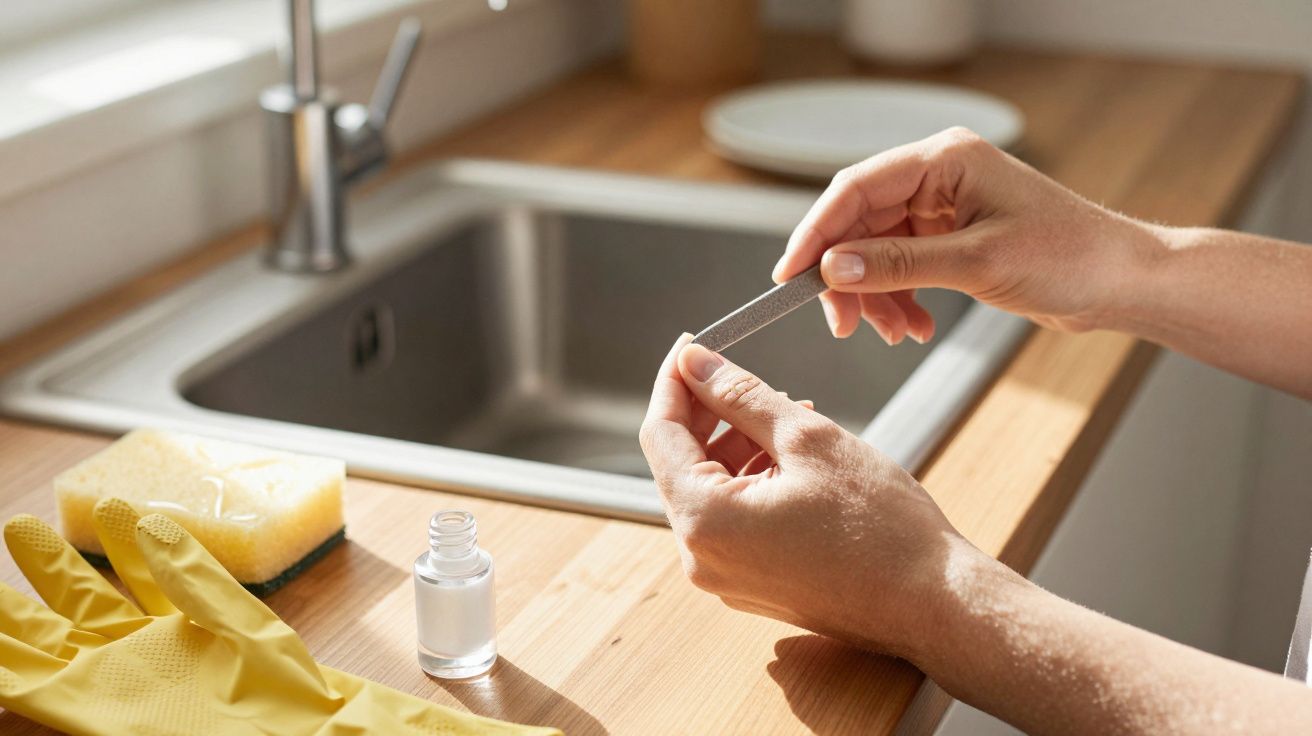
The first time nail shapes really matter is never at a salon chair - it’s at a kitchen sink, a laptop keyboard, or the moment you fumble keys in the front door. Everyday wear asks for strength balance: enough structure to resist bending and snapping, without a sharp corner that catches on everything you touch. Most “breaks” aren’t dramatic; they’re slow stress fractures caused by tiny impacts, repeated a hundred times a day.
I learned this the hard way after choosing a pointy style before a week of moving house. By day three, one nail had a split you could feel on fabric, and by day five I was filing everything down on the edge of a cardboard box. Durable nails aren’t about being boring. They’re about choosing a shape that fits real life.
Durability isn’t a vibe: it’s physics at the free edge
A nail’s weakest points are its corners and its longest, thinnest bits. The more you extend the free edge (the part past your fingertip), the more leverage daily tasks get to pry and flex it.
Sharp corners act like hooks. They snag, then the snag becomes a tear, and the tear becomes a split that travels down the side wall. The strongest shapes reduce corner stress and spread pressure evenly across the tip.
If you want nails that survive washing up, gym grips, childcare, and commuting, you’re choosing where force goes - and whether it has a clean exit path or a place to concentrate and crack.
The best nail shapes for everyday durability (ranked for real life)
There’s no single “strongest” for everyone, but there are clear winners once you factor in length, nail thickness, and how rough your days are.
1) Rounded (short round): the quiet champion
Short round is what your nail would naturally become if you never tried to make it fashionable. The edges are softened, the corners are gone, and there’s nothing to catch.
It’s also forgiving if your nails are thin, bendy, or prone to peeling. If you type all day or do a lot of cleaning, this shape usually outlasts everything else at the same length.
Best for: thin nails, frequent handwashing, messy jobs, anyone who wants “set and forget”.
2) Squoval: square strength without the corner penalty
Squoval keeps a flatter tip (which many people find looks neat and modern) but rounds off the corners that cause most tears. That tiny curve at each corner is the difference between “lasts two weeks” and “splits on day four”.
It’s a great compromise when you like a clean line but don’t want the snagging behaviour of a true square.
Best for: average-strength nails, office work, people who like a tidy look but hate maintenance.
3) Oval: elegant, but only if you keep it sensible
Oval can be durable because it removes corners and distributes force, but it gets riskier as length increases. Longer oval tips can flex more, especially if your natural nails are thin.
Keep oval at a modest length and it’s one of the better shapes for preventing side splits. Push it long and it starts behaving like a softer almond.
Best for: medium-length wearers, nails that grow well but don’t love sharp filing.
4) Short almond: durable if your nails are strong (or supported)
Almond looks strong because it tapers, but it can be a trap on natural nails if you go long. The tapered sides can thin out with repeated filing, and the tip becomes a stress point if you use your nails as tools (everyone does, occasionally).
If you wear a strengthening base coat, builder gel, or your nails are naturally sturdy, short almond can be surprisingly resilient while still looking “done”.
Best for: stronger nails, gel wearers, anyone who wants style without full fragility.
5) Square: neat, but the corners are a liability
Square nails are the most likely to catch, especially on hair, pockets, towels, and bedding. That corner snag is small, but the force it creates is not.
Square can work if you keep it very short and your nails are thick, but for many people it’s the shape that breaks “mysteriously” even when you’re careful.
Best for: very short nails, thick nail plates, people who don’t mind frequent minor repairs.
6) Stiletto/coffin (long): high drama, low durability
These shapes put length and thin edges together - exactly what everyday life punishes. Coffin (ballerina) adds flat corners at the tip; stiletto concentrates force into a point.
They can be wearable with strong overlays (acrylic/hard gel) and careful habits, but on natural nails they’re the fastest route to cracks that ruin your week.
Best for: special occasions, enhancements, people who are happy to trade durability for look.
How to choose your “durable default” in 60 seconds
Stand under a bright light and look at two things: your side walls (do they peel?) and your tip (does it bend when you press gently?).
Then pick your baseline:
- If your nails bend easily: go short round or short squoval.
- If your nails are average and you want a neat tip: go squoval.
- If your nails are strong and you want a softer silhouette: go short almond or oval.
- If you keep breaking one corner: your nails are begging you to abandon true square.
Let length be your “volume knob”. Whatever shape you love becomes more durable when you shorten it by just 1–2 mm.
Small habits that make any shape last longer
People hunt for the perfect file technique and miss the boring truth: durability is mostly about reducing stress and keeping the nail sealed.
- File in one direction with a fine grit (180+ for natural nails) to reduce fraying.
- Slightly round the corners even if you like square - you’ll barely see it, you’ll absolutely feel it.
- Cap the free edge with top coat (and re-cap every few days if you’re hard on your hands).
- Wear gloves for washing up and cleaning; repeated wet-dry cycles make nails swell and weaken.
- Stop using nails as tools for stickers, can tabs, or scraping labels. That leverage is what creates splits.
Let’s be honest: nobody does all of this every day. If you do just one thing, make it corner-softening. Corners are where durability goes to die.
A quick cheat sheet: shape, risk, and who it suits
| Shape | Durability level | Best fit |
|---|---|---|
| Short round | Very high | Thin/bendy nails, busy hands |
| Squoval | High | Most people, low-maintenance neat look |
| Oval | Medium–high | Moderate length, fewer corner breaks |
| Short almond | Medium | Strong nails or enhancement wearers |
| Square | Medium–low | Very short, thick nails only |
| Long coffin/stiletto | Low | Enhancements, careful lifestyle |
FAQ:
- Which nail shape breaks the least for natural nails? Short round is usually the most durable because it removes corners and reduces snagging.
- Is squoval stronger than square? For everyday durability, yes. Squoval keeps the clean look but softens the corners where splits often start.
- Do almond nails last on natural nails? They can, but keep them short. Longer almond shapes tend to flex more and can thin at the sides with repeated filing.
- What if I love square nails but they keep catching? Keep them very short and slightly round the corners. You’ll keep the vibe while removing the main failure point.
- Does gel or builder base change the best shape? It can. Added structure improves strength balance, making oval or short almond more realistic if your natural nails are thin.




Comments (0)
No comments yet. Be the first to comment!
Leave a Comment